CHAPTER V ________________ Arrival of other Missionaries – From 1797 – 1803 _________________

Rev. M. Fournier – Traits and facts of his early life – His arrival in Kentucky – His stations and labours – His character – His sudden death – Rev. M. Salmon – His zeal and labours – Humorous incident – His tragical death – His Epitaph – Rev. Mr. Thayer – Anecdote of Franklin – Mr. Thayer’s conversion – His labours in Boston – In Kentucky – And in Limerick – His death

For about three years M. Badin had been alone, desolate in heart, and weighed down with labours. At length, Divine Providence took compassion on his lonliness, and sent other labourers into a harvest now become much too extensive to be cultivated by one man. The new missionary recruits were from among those illustrious clerical exiles from France, to whose apostolic zeal America is so greatly indebted, and without whose generous aid our infant missions could scarcely have been sustained.

The first of these who arrived in Kentucky, was the Rev. M. Fournier, in the year 1797. He was a native of the Diocess of Blois in France; and, when driven from his native country, by the French Revolution, he took refuge in England. In London he taught French language for about four years, in order to obtain a subsistence. Weary of this manner of life, and panting for a field of action more congenial to his zeal for the salvation of souls, he sailed for America, which he reached towards the close of the year 1796. He immediately offered his services to Bishop Carroll, who gratefully accepted them, and immediately sent him to Kentucky to the assistance of M. Badin, of whose melancholy condition he had been already well apprised.

M. Fournier, after a long and painful journey, in the dead of the winter, reached Kentucky in February, 1797. M. Badin received him with open arms, and extended to him for several months the hospitality of his own log cabin of St. Stephen’s. M. Fournier soon purchased on hundred acres of ground, on the Rolling Fork – the site of the present Holy Mary’s – and, after having erected a temporary hut, removed thither in 1798. He then took charge of a portion of M. Badin’s stations. He attended the congregations situated on the Rolling Fork, on Hardin’s Creek, on Cartwright’s Creek, on Rough Creek in Hardin County, with those at Danville, and in Madison county. When we reflect that a distance of at least one hundred and twenty miles intervened between the two extreme points of this circuit, we will probably come to the conclusion, that, like his fellow-labourer in the same field, he was certainly in no lack of employment.

He was an excellent priest; pious, zealous, laborious, and punctual to all his appointments. He was of ordinary size, but had a thin visage, furrowed with care, but still beaming with habitual cheerfulness. His manners were extremely popular; he soon caught the spirit, and adapted himself to the manners of the country; and he had not one personal enemy. He spoke English remarkably well, and preached sermons which had the triple merit of being solid, short, and intelligible to the meanest capacity.

When not engaged in his missions, he was almost constantly laboring on the little farm adjoining his residence. His death was caused by the rupture of a blood-vessel through over exertion in raising large beams of wood, to be sawed into plank. It was so sudden, that his friend, M. Badin, arrived only in time to assist at his funeral. His body was interred at the church of Holy Cross. He had not yet reached his fiftieth year.

Another French priest, M. Salmon, reached Kentucky in February, 1799. He was from the same Diocess of Blois, and was an old and long tried friend of M. Fournier, with whom he had been a fellow student in the Diocesan Seminary of Blois,[1] as well as his associate in exile from his country. The two friends had met and passed some years together in London. After the arrival of M. Fournier in Kentucky, he wrote to his friend in London, who followed him as soon as he could make the necessary arrangements. He was about forty-two years of age, was of a delicate frame, and, like M. Fournier, was well versed in the English language.

M. Badin, who was Vicar General, assigned him the stations at Hardin’s Creek, Poplar Neck, Mr. Gardiner’s, and Bardstown. He was zealous and indefatigable in the discharge of all his missionary duties. Especially did he labour without intermission for the instruction of children and servants in their catechism. In whatever Catholic house he visited, he made it an invariable rule to examine the children on their knowledge of their Christian duties. And, as we shall soon see, his premature death was the consequence of his burning zeal for the salvation of souls.

The following humorous incident is, perhaps, not worth recording, though it may serve to illustrate his zeal for the instruction of poor servants. When he was at the house of Mr. Thomas Gwynn, near Bardstown, he undertook as usual to instruct the servants in their religion. He had them all assembled, and was struck by the readiness of their answers. His gravity was, however, not a little disturbed, when, on his asking a servant girl of 16 – “which is the last sacrament you would like to receive were you on the point of death?” She answered immediately – thinking of the last one on the list – “Matrimony.”

His zeal was rewarded with abundant fruits; though it pleased God, in the unsearchable ways of His Providence, speedily to put an end to his labors and sufferings on this mission. He had been in Kentucky but nine months, when his career was suddenly cut short by death. He was the first priest who died on this laborious mission – and he fell a martyr to his zeal.

In the discharge of his duties, he had caught a violent cold, which confined him to his bed for six weeks, in the house of M. Badin. When convalescent, he determined to visit the station at Mr. Gwynn’s, where he had an appointment to meet a Protestant lady whom he was instructing and preparing for Baptism.[2] He was a bad horseman, and was still very feeble from his previous sickness. It was the ninth day of November, 1799; and the snow covered the ground, concealing a road which was rugged and difficult. M. Badin endeavored to dissuade him from undertaking the journey, in his debilitated condition; but he was firm in his resolution, and departed at an early hour in the morning.

About a mile from Bardstown, on the road to Mr. Gwynn’s, he was thrown violently from his horse, and was dashed against a tree. He was stunned and mortally wounded, in the breast and head. In his struggles, he succeeded in dragging himself to a tree, against which he leaned his head and shoulders, and thus set up right, near the roadside. From 12 o’clock until night, he remained in this dreadful situation, surrounded by the snow, benumbed with the cold, and in the very agonies of death. A lad, who was cutting wood in the neighboring forest, soon discovered him in this condition, and requested permission from his employer, to repair to his assistance. But the overseer[3] brutally replied, that was only “only a – priest who was probably a drunk!” Near sunset, this man saw Mr. Gwynn passing, and shouted out to him, that “his priest was lying in a certain spot, perhaps dying.”

The good Mr. Gwynn, deeply affected, flew to the spot, where he discovered that his worst anticipations were more than realized. M. Salmon seemed on the very point of death. He was immediately placed on horseback, and conveyed, with as much tenderness as possible, to the residence of Mr. Gwynn, about a mile distant. Messengers were speedily dispatched for positions, and for the Rev. M. Badin. The latter arrived at two o’clock the same night, having rode about 16 miles in a little more than two hours. He found M. Salmon insensible, reciting occasionally prayers in Latin, and acting as though he fancied himself at holy altar. M. Badin administered to him the last sacraments, and remained with him till his death, which took place on the following night, the 10th of November. His remains were conveyed to the church of Holy Cross, where they were interred with all the ceremonies of the Roman Ritual.

M. Badin wept bitterly over the death of a friend and fellow-labourer, whom he was so sincerely attached. He composed for him Epitaph in Latin verse, of which the following is a translation:   “Here lies Anthony Salmon a French Priest of eminent virtue, who preferred exile to schismatical wealth, leaving father, mother, and country. Let piety weep, and religion pour forth her prayers,” for his repose.[4]

The worthy patriarch of the American church, Bishop Carroll, seemed to take a special interest in the missions of Kentucky. In the same year of M. Salmon’s death, he sent out another zealous missionary labour in this distant field. The Rev. Mr. Thayer arrived in Kentucky in the year 1799. He was the first native of America who exercised the holy ministry in our State. He had been a Presbyterian or Congregationalist minister at Boston; and had been reared with all that bitter hostility to the holy Catholic Church so common to his sect.

While yet a Protestant preacher, he determined to travel through Europe. He reached Paris, while Benjamin Franklin was residing there, in quality of Minister of the United States to the French Court. He visited Franklin, and requested to be appointed his Chaplain. The philosopher – statesman made him the characteristic reply: that he could “say his own prayers, and save his country be expense of employing a Chaplain.” Thus foiled in his object, Mr. Thayer proceeded to Rome, which he reached, probably, about the year 1781. He repaired thither with the full expectation of being able to collect facts to establish conclusively the idolatry of the Catholic Church; that he left the “Eternal City” an ardent Catholic himself.

The immediate occasion of his conversion was his witnessing the wonderful miracles operated at the tomb of the venerable Labre. These he ridiculed, at first; but a long and rigid scrutiny convinced him that they were the work of God. His next inference was natural – that the religion in favour of which such prodigies had been operated, must be the religion of Christ; since God cannot stamp the broad seal oh his approbation on falsehood and error. His conclusions were strengthened by a full examination of the evidences which demonstrate the truth of Catholicity. With a simple and docile heart, he committed himself wholly to the teaching of God, whose light and grace he frequently invoked in prayer. A new light broke upon his mind; and his previous prejudices vanished like the mist before the rising sun. He soon beheld himself in the clear and unclouded day of Catholic truth; and returned humble thanks to God for having thus vouchsafed to transfer him from the region of doubts and darkness, into the admirable light of His Blessed Son!

Ardently did he pant for an opportunity to impart to others, reared up with similar prejudices, the new light which had broken upon his own spirit. He determined to cast all human considerations to the winds, and to devote his whole subsequent life to the sublime occupation of endeavoring to enlighten others, especially his countrymen. The better to qualify himself for this undertaking, he resolved to enter into the Catholic ministry. Accordingly, after the necessary previous studies, he was ordained priest in Paris; after which he speedily returned to the United States.

He was stationed in Boston, the theater of his former labors as a Protestant minister. He held weekly conferences on the truths of the Catholic faith; and his discourses, delivered with much earnestness and eloquence, attracted great crowds of his Protestant fellow-citizens. He published a detailed and well-written account of his conversion, in which he clearly and forcibly stated all the motives which had led him to take this important step. He thus endeavored to convey his own convictions to the minds of his countrymen, both from the pulpit and through the press. His zeal led him into various controversies with the Protestant preachers; and he always showed himself able to give an account for the “hope which was in him.” Still he had the mortification to find, that the Americans, who are so easily misled by novelties of whatever species, are very slow to change their religious opinions, especially in favor of what is old in painful human nature. He found that conviction and conversion were two different things; and that, though he could flatter himself with having brought about the former state of mind in many, he was cheered by but few evidences of his having secured the latter.

Feeling, probably, that “no prophet is received in his own country,” he left Boston; and, after having visited Canada, offered his services to Bishop Carroll, for whatever mission in the Union he might think proper to assign him. As we have said, Bishop Carroll sent him to Kentucky. Here he remained for about four years, during two of which only he was engaged in the ministry.

He left Kentucky in 1803; and subsequently went to Ireland. He exercised the holy ministry for many years in Limerick, where he contributed greatly towards the revival of piety. The year of his death we have not been able to ascertain with precision; but it certainly occurred sometime before the year 1822. When M. Badin was in Paris during this year, he received, from respectable Irish gentleman of Limerick, a glowing account of his zealous labours and edifying death. Among other particulars, the gentleman alluded to mentioned the fact, that Mr. Thayer had induced about 200 of his penitence to make their meditation daily.[5]

[1] Conducted by the Lazarists

[2] This lady afterwards became an exemplary member of the Catholic church.

[3] For the honor of human nature, we must observe that this was a man of no standing in the country; and his brutality is almost single in the early history of Kentucky. The lad of whom mention is made above, is now one of our most respectable citizens.

[4] “Hie jacet Antonius Salmon Virtute verendus, Presbyter e Gallis; proetuht exilium Schismaticis opibus; fratres, matrem, arvaque linquens: Det pietas fletus, Religioque preces.”

[5] In the facts detailed in this chapter, we have followed the admirable report on the Kentucky missions, drawn up by M. Badin, in 1822, and published in the Annales. (loco sup. cit.)  We have added several important facts, derived from the oral statements of the Very Rev. M. Badin, and from other aged persons, who were well acquainted with the individuals of whom we have spoken.


CHAPTER IV ________________ Reverend M. Badin in Kentucky [1] – From 1793 to 1797

The French Revolution – Virtues of the exiled French Clergy – M. Badin – His early studies – Anecdote – His firm attachment to the faith – He sails for America – Singular coincidence – Anecdote of Bishop Carroll – M. Badin appointed to the missions of Kentucky – Characteristic conversation between him and Bishop Carroll – Departure for Kentucky – Delay in Gallipolis – Arrival – M. Barrieres – M. Badin alone in Kentucky – His troubles – Christian friendship –    M. Rivet – M. Badin’s labours in Kentucky – His missionary stations – Teaching Catechism – Morning and evening prayer – His Maxims – Curious anecdote – Hearing confessions – Dancing – Anecdotes – Strange notions respecting Catholic priests – M. Badin’s privations – His disinterested zeal – His dangers and adventures – How to cure the pleurisy – St. Paul

The tide of emigration had continued to set so strongly towards Kentucky, that, on its admission into the Union, in 1792, the population amounted to about 70,000. The Catholic portion of this large population had been, in great measure, deprived of all pastoral succor, since the departure of F. Whelan, in 1790. The next mission to this remote part of the vast Diocess of Baltimore, was commenced under the better auspices, and was destined to be permanent.

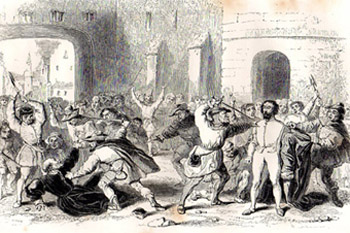
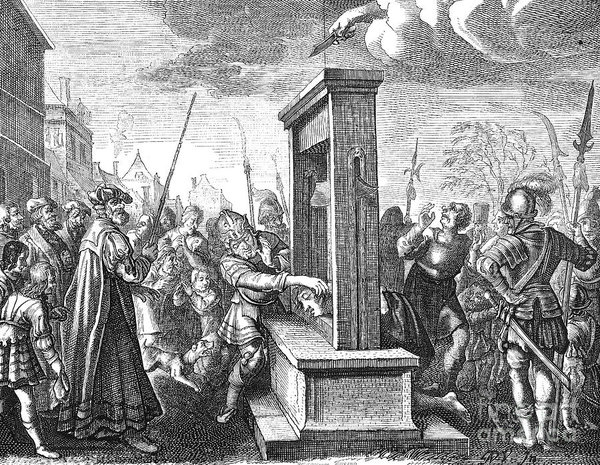
The French Revolution had declared a war of extermination against the Catholic religion and clergy. Many of the latter had been driven from France, and compelled to seek shelter in England, Spain, and the United States. The ways of Divine Providence are truly admirable: God often draws the greatest good out of the greatest evil. Many of the most zealous of the French clergy, expelled from their native country, transferred their labours to other lands, and scattered the good seed of the Gospel on the soil of distant regions. Thus persecution, instead of destroying religion, served rather to diffuse it over the world. The exiled clergy of France, in conformity with the advice of our Blessed Lord, when persecuted in one city, fled to another; spreading wherever they went the good odour of Christ. By the fruits which their zeal every where produced, God proclaimed the virtues of his persecuted servants, and confirmed the divinity of a religion, the spirit of which persecution could not quench, or even diminish.

257_Massacres

guillotine-16th-century-granger

The Catholic Church in the United States is deeply indebted to the zeal of the exiled French clergy; no portion of the American church owes more to them than that of Kentucky. They supplied our infant missions with most of their earliest and most zealous labourers; and they likewise gave to us our first Bishops. There is something in the elasticity and buoyancy of character of the French, which adapts them in a peculiar manner to foreign missions. They have always been the best missionaries among the North American Indians; they can mould their character to suit every circumstance and emergency. They can be at home and cheerful every where. The French clergy who landed on our shores, though many of them had been trained up amidst all the refinements of polished France, could yet submit without a murmur to all the hardships and privations of a mission on the frontiers of civilization, or in the very heart of the wilderness. They could adapt themselves to the climate, and mould themselves to the feelings and habits of a people congenial to them in temperament and character.

One of these French clerical refugees, the Rev. Stephen Theodore Badin, was the man appointed by Divine Providence to succeed the Rev. F. Whelan in the missions of Kentucky, and to become one of the chief religious pioneers of the west. This indefatigable and venerable missionary, still lingering above the horizon of life, celebrated during the last year, the fiftieth anniversary of his arrival in Kentucky, by offering up the Holy Sacrifice in Lexington, the first place at which he had said Mass on his reaching the State. Before we speak of his missionary labours among us, a few incidents of his early life will not, perhaps, be out of place.

M. Badin was born of pious parents, at Orleans, in France, on the 17th of July, 1768. He was the third of fifteen children, and the oldest son. His parents, pleased with the sprightliness of his mind, determined to give him a finished classical education. They accordingly sent him to the College Montagu in Paris, where he remained for three years. He distinguished himself among his fellow students, and soon mastered the ancient classical writers so thoroughly, that he can quote them with facility even to this day. While at this college, he gave frequent evidences of that ready wit for which he was so conspicuous in after life. We will give one little incident of this kind.

His professor of Greek was as remarkable for his penuriousness as he was for his ardent attachment to the ancient Greek authors. He often gave his lessons to youths trembling with cold, though it was his place to have the lecture room warmed at his own expense. One day, he was lecturing on the beauties of Homer, and in his enthusiasm remarked to his shivering hearers, that reading Homer was enough to warm anyone. “It is at least very cheap fuel” – remarked M. Badin, looking significantly at the two little sticks of wood on the fire. All the students smiled, and the professor had a blazing fire in the room the next day.

Having determined to study for the church, he, in the year 1789, entered the flourishing Theological Seminary conducted by the Sulpicians, at Orleans. Here he remained for two years, until the Seminary was dissolved, in 1791. The circumstances which attended its dissolution served to set forth, in the strongest light, the unalterable attachment of M. Badin to the Catholic faith, and that unyielding firmness of purpose, which was a principal feature in his character throughout life. The Bishop of Orleans had unhappily taken the odious constitutional oath; and M. Badin, with the great body of the seminarians, determined that he would not be ordained by such a prelate. Accordingly, early in July, 1791, about a week before the great anniversary of the taking of the Bastile, he and the majority of his companions left the seminary, fearing, also, that on that day they might be involved in difficulties about the oath.

Not being as yet in Holy Orders, he returned to his parents, with whom he remained until the 3rd of November, 1791; at which time he left his father’s house for Bordeaux, where he had determined to embark for America. Here he met with Rev. MM. Flaget and David, whose company he enjoyed on the voyage. Divine Providence thus caused the three men, who were afterwards destined most to signalize their zeal on the missions of Kentucky, to meet together from different parts of France, without any previous concert, and to sail on the same ship for America. After many years of Arduous missionary duty, in different parts of the United States, these same three devoted missionaries met again amidst the waving forests of our State, where two of them are yet living.

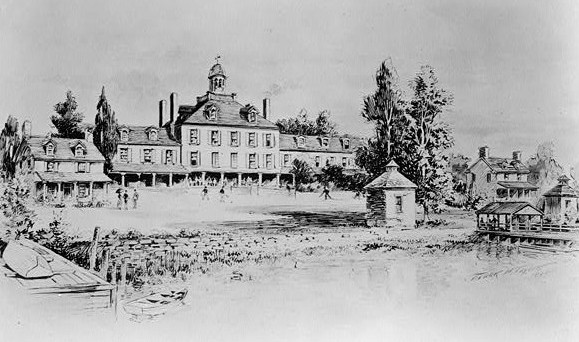
These distinguished exiles from France reached Philadelphia on the 26th, and Baltimore on the 28th of March, 1792. They found that another illustrious colony of French priests had already arrived in Baltimore, six months before.[2]

Lazaretto-1895

Early on the morning following their arrival in Baltimore, the exiles went to pay their respects to Bishop Carroll. They met him on the way hastening to pay them the first visit; and they apologized to him for the tardiness which had prevented them from visiting him first. Bishop Carroll, smiling and bowing to them, said, with in effable grace and dignity: “it is surely little enough, gentlemen, that I should be the first to visit you, seeing that you have come 1500 leagues to see me.”

M. Badin was ordained priest by Bishop Carroll, in the old cathedral of St. Peter’s, on the 25th of May, 1793. He was the first priest that was ever ordained in the United States. He shortly afterwards went to Georgetown College, to perfect himself in the knowledge of the English. To show the rapid increase of Catholic clergymen in the United States, at that time, we may here mention the fact, that, when F. Whelan was sent to Kentucky, in 1787, there were scarcely twenty in the whole Union; whereas there were twenty-four who attended the first Synod held in Baltimore by Bishop Carroll, in 1791, besides a great number employed on the distant missions.

John_Carroll_Gilbert_Stuart

Bishop John Carroll

The mission of Kentucky still continued in a destitute condition; and Bishop Carroll’s zeal for all portions of his extensive flock was quickened by frequent and urgent applications for a pastor from the Catholics of that distant region. He selected M. Badin for this arduous mission, and soon communicated his wishes to him. M. Badin manifested great reluctance to undertake so difficult a task; he represented his youth – he was but twenty-five years of age – his slight acquaintance with the English language, and his inexperience. He earnestly requested that some one of more mature age, and better qualified, might be appointed. Bishop Carroll listened to his reasons with great meekness; and finally proposed that no decisive step should be taken for nine days, during which both should unite in prayer, and recommend the matter to God, by performing a novena in unison. M. Badin acceded to the proposal, and departed. On the ninth day he returned according to appointment, when the following characteristic conversation took place.

Bishop Carroll: ‘Well, M. Badin, I have prayed, and I continue still in the same mind.”

M. Badin, smiling: “I have also prayed; and I am likewise of the same mind as before. Of  what utility, then, has been our nine days’ prayer?”

Bishop Carroll smiled too; and after a pause, resumed with great dignity and sweetness: “I lay no command; but I think it is the will of God that you should go.”

M. Badin instantly answered with great earnestness: “I will go, then,” and he immediately set about making the necessary preparations for the journey.

The event justified Bishop Carroll’s choice. The buoyant elasticity, the persevering zeal, and the indomitable energy of M. Badin’s character, had not escaped his quick eye; and his great forecast and wonderful power of discriminating character, were not, at least in the present instance, at fault. Perhaps, among all the clergy attached to the vast Diocess of Baltimore, at that time, there was not one better suited to the rugged mission of Kentucky, than M. Badin.

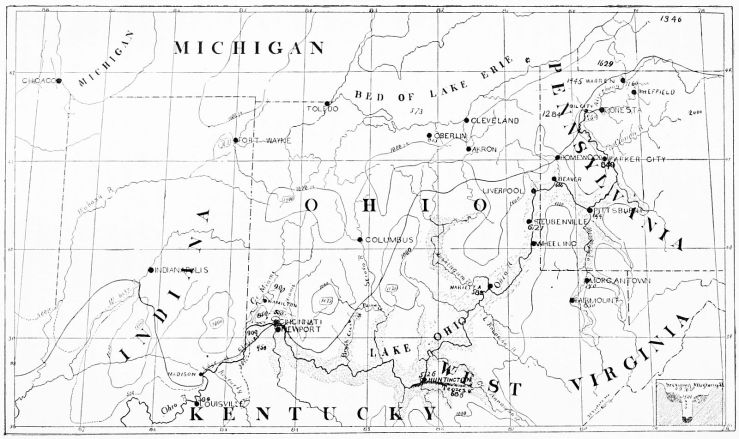
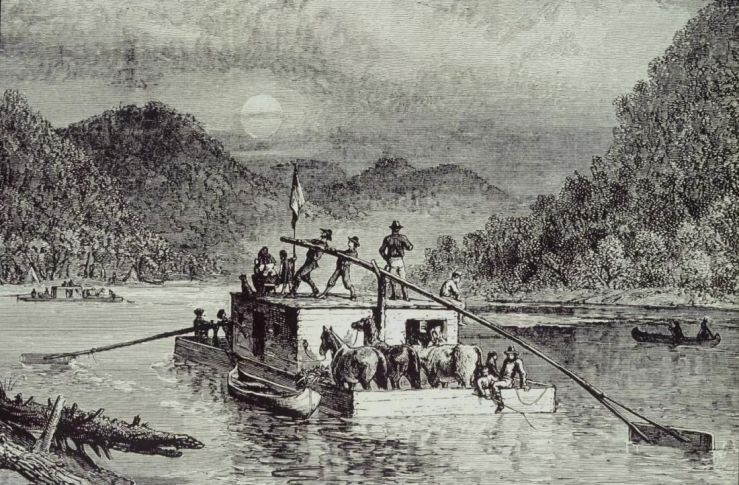
Bishop Carroll, in consideration of M. Badin’s youth, assigned to him as a companion a more aged clergyman – the Rev. M. Barrieres, who was constituted Vicar General in the distant missionary district. The two missionaries left Baltimore on the 6th of September, 1793, and travelled, like the Apostles, on foot to Pittsburgh, over bad roads and a rugged wilderness country. On the 3rd of November, they embarked on a flat boat, which was descending the Ohio, in company with six others. These boats were all well armed, for fear of an attack from the Indians. About that time, however, Gen’l. Wayne was preparing his great expedition against them; and they had enough to do to defend their own wigwams, without prowling about near the frontier settlements.

PSM_V45_D200_Map_showing_the_contours_of_the_ohio_valley

The boats were seven days in going down to Gallipolis; and between this place and Pittsburgh, the travellers saw but two small towns – Wheeling and Marietta. The two priests remained for three days at Gallipolis, the inhabitants of which place were French Catholics, who had been long without a pastor. They heartily welcomed the missionaries, who, during their brief stay, sang High Mass in the garrison, and baptized forty children. The good French colonists were delighted; and shed tears on their departure. They were but a remnant of a large French colony of about 7000, who had emigrated to America four or five years previously. A French land company had purchased for them a large territory on the Scioto river; but the title to these lands proved defective; the colonists were defrauded, and many of them returned in disgust to France, bitterly inveighing against Yankee shrewdness in bargaining.

flatboat_on_the_ohio_circa1788

The two missionaries landed at Limestone, or Maysville, where there were at that time about twenty families. They proceeded on foot to Lexington, a distance of about 65 miles. They passed the first night in an open mill, six miles from Limestone, lodging on the mill-bags, without any covering, during a cold night, late in November. On the next day, they passed the battleground of Blue Licks, where M. Barrieres picked up a skull of one of those who had fallen there eleven years before. He carried it with him, and retained it, as a relic of the disastrous battle, and as a memento of death. On the first Sunday of Advent, M. Badin said Mass, for the first time in Kentucky, at Lexington, in the house of Dennis M’Carthy, an Irish Catholic, who acted as clerk in the commercial house of Col. Moyland, brother of the then Bishop of Cork.

The missionaries had with them but one chalice; and after having offered up the Holy Sacrifice, M. Badin travelled sixteen miles, to the Catholic settlement in Scott County, where M. Barrieres said Mass on the same day. Preparations were then in progress to erect in this place a frame church. M. Badin remained in Scott county for about eighteen months, occasionally visiting the other Catholic settlements in Kentucky; M. Barrieres proceeded immediately to take charge of the Catholic families in the vicinity of Bardstown.

The difficulties of the times, and the rude state of society in the infant colonies, soon determined M. Barrieres to leave the country. His habits had already been formed, and he thought that he could not adapt himself to the new state of things in the wilderness. Accordingly, about four months after his arrival in Kentucky, he left the State. In April, 1794, he departed from Louisville, in a pirogue[3] for New Orleans, which, with all Louisiana and Missouri, was then in possession of the Spaniards.

The Spanish government was at that time apprehending an attack on Louisiana from the French Republic; and M. Barrieres, being a Frenchman, was arrested and detained for some time at New Madrid. He immediately wrote to Baron Carandolet, the Spanish Governor of Louisiana, representing the objects of his visit; and the Baron soon liberated him, and permitted him to proceed without further molestation, to New Orleans. Shortly after his arrival in this city, he went to Attakapas, where he labored zealously in the missions for nearly twenty years. In 1814, he sailed for Bordeaux, where he died eight days after his arrival. About twenty-three years before, he had escaped from a prison of this city, and from the death which probably awaited him at the hands of the French Jacobins; and he had sailed from this port to America; and now he returned to the same place to breathe his last.

M. Badin was now left alone in the heart of the wilderness. Keenly as he felt the desolation of heart which this state of isolation brought with it, he yet reposed his whole trust in God, who abundantly consoled him in all his tribulations. He remained alone for nearly three years, and was at one time twenty-one months without an opportunity of going to confession. He had to form the new congregations, to erect churches as suitable places, and to attend to the spiritual wants of the Catholic settlements scattered over Kentucky; and he had to do all this alone, and without any advice or assistance. Well might he exclaim; “Oh! How much anguish of heart, how many sighs, and how many tears, grow out of a condition so desolate!”[4] Still he was not cast down, notwithstanding all his perplexities.

His mind was also soothed by the cheering voice of friendship. The nearest Catholic priest was M. Rivet, who was stationed at Post Vincennes in 1795, shortly after the departure from that station of the illustrious missionary pioneer, the Rev. M. Flaget. In France, he had been professor of Rhetoric in the College of Limoges: and he still continued to write Latin poetry with case and elegance. He occasionally sent his Latin poems to M. Badin, who also, as we shall see, excelled in this species of composition. When the French Revolution burst over Europe, M. Rivet took refuge in Spain, where the Archbishop of Cordova made him his Vicar General, for the benefit of the numerous French refugees who had taken shelter beyond the Pirrenees.

He and M. Badin mutually consoled each other, by carrying on as brisk a correspondence as the difficulties of the times would permit. There were then, however, no post offices in the west; and the frowning wilderness which interposed between the two friends rendered the exchange of letters extremely difficult; and wholly precluded the possibility of their visiting each other; even if this had been permitted by the onerous duties with which each was charged. M. Rivet had discovered at Vincennes a precious document of the old Jesuit missions among the Indians of the northwest. It consisted of two large folio volumes in manuscript, containing the Mass, with musical notes, and explanations of it, together with catechetical instructions, in the Indian language. This document has probably since disappeared.

When M. Badin first came to Kentucky, he estimated the number of Catholic familes in the state at three hundred. These were much scattered; and the number was constantly on the increase, especially after Wayne’s victory in 1794, and the treaty of Greenville in the following year. There was then but one Catholic in Bardstown – Mr. A. Sanders, to whose liberality and generous hospitality the clergy of the early church in Kentucky were so much indebted.

He found Catholics suffering greatly from previous neglect, and in a wretched state of discipline. Left alone, with this extensive charge, he had to exert himself to the utmost, and, as it were, to multiply himself, in order to be able to meet every spiritual want of his numerous flock. As the Catholics were then almost wholly without churches or chapels, as he was under the necessity of establishing stations at suitable points, in private houses. These stations extended from Madison to Hardin county – a distance of more than a hundred and twenty miles; and to visit them all with regularity, he was compelled almost to live on horseback. He estimates that, during his sojourn in Kentucky, he must have rode on horseback at least 100,000 miles. Often was he exhausted with his labours, and weighed down with the “solicitude of all the churches.”

His chief stations during this time were those at Lexington, in Scott county, in Madison county, in Mercer county – where there were then about ten families – at Holy Cross, at Bardstown, on Cartwright’s Creek – two miles from the present church of St. Rose – on Hardin’s Creek, on the Rolling Fork, in Hardin county, and at Poplar Neck on the Beech Fork.

In all those places, except Madison and Mercer counties,[5] there are now fine brick churches; but at the period of which we are speaking, there was not one of any kind, except a miserable log chapel, on the site of the present church of Holy Cross; and this had been erected at the instance of M. De Rohan, before the arrival of M. Badin in Kentucky. This temporary hut was covered with clapboards, and was unprovided with glass in the windows. A slab of wood roughly hewed, served for an altar. Such was the first Catholic church in Kentucky! As it was situated near the centre off the Catholic settlements, M. Badin soon took up his residence near it; and it then became the central point of his mission, and the alma mater of Catholic churches in Kentucky. He subsequently erected a temporary chapel at his own residence, three miles from Holy Cross; this he called St. Stephen’s, after his patron Saint.

M. Badin was indefatigable in his efforts to awake piety, and to restore a proper discipline among his flock. He insisted particularly on having servants and children taught the catechism. At every station he had regular catechists, whose duty it was to teach them the elements of the faith. He displayed on all occasions particular zeal in the instructions off poor servants off colour. Whenever he visited a Catholic family, it was his invariable custom to have public prayers, followed by catechetical instructions. He every where inculcated by word and example the pious practice of having morning and evening prayer in families. He was in the habit of repeating to children, in his usual emphatic and pointed manner, the following maxims; “My children, mind this; no morning prayer, no breakfast; no evening prayer, no supper;” and “my children, be good, and you will never be sorry  for it.”

His zeal for promoting the regular practice of morning and evening prayers, occasionally betrayed him into some eccentricities. Once, a man travelling to the Green river country, called at his residence at St. Stephen’s, at a late hour in the evening, requesting permission to stay during the night. M. Badin cheerfully granted the request, telling him at the same time, that he was a Catholic priest, and could charge nothing for his hospitality. The man looked a little shy, but thanked him for his kindness. When, after supper, he was about to retire to rest, M. Badin asked him, whether he had said his night prayers? The man looked blank, and answered in the negative. “Well,” rejoined M. Badin, “I have already said my prayers, but I will cheerfully say them again to accommodate you, and to bear you company.” Then he immediately fell on his knees, the man following his example, and said aloud the usual prayers. As he was lighting his guest to his room, he told him, “that he might die before morning, and that he should never retire to rest without preparing himself for death.” On the next morning, M. Badin went to awake the stranger, but he had, it seems, said prayers enough already, and had escaped before the dawn of day.

On reaching a station, M. Badin would generally hear confessions till about one o’clock. Meantime, the people recited the Rosary at intervals, and the boys, girls, and servants, were taught catechism by the regular catechists. Hearing confessions was the most burdensome duty he had to discharge; and he was fully aware of its deep and awful responsibility. He spared no labour nor pains to impart full instructions to his penitents, who thronged his confessional from an early hour. So great, in fact, was their number, that he found it expedient to distribute among them tickets, fixing the order in which they should approach the holy tribunal, according to priority of arrival at the church. He was a thorough tactician, and was inflexible in maintaining this order. Frequently, persons would be obliged to make several attempts before they could succeed in going to confession.

He was always an implacable enemy of dancing, which, in the rude state of society at that early period, was often attended with great disorders. The following amusing anecdotes will illustrate the manner in which he warned against the practice.

Some time in the year 1795, or 1796, the Catholics on Pottinger’s Creek got up a dancing school and employed an Irish Catholic as a dancing-master. In his regular visit to the neighbourhood, M. Badin repaired as usual to the station on Saturday evening, to hear confessions and to teach catechism to the children. He found very few in attendance, and soon learned that they were all gone to the dancing-school, at a neighbouring school-house. He immediately went thither himself, and his appearance disturbed, in no slight degree, the proceedings of the merry assemblage: “My children,” said he, smiling, as he stood in the middle of the room, “it is all very well: but where the children are, there the pastor must attend.” He caused them all to sit down, and he gave them a long lesson in their catechism. On the following morning, he said Mass for them in the same apartment, and caused the dancing-master himself to attend.

74a44e5c18d84ca8cba9541da2d3cd10

He sometimes arrived unexpectedly at a house, in the evening, while dancing was going on, glided into the room before any one perceived it, and told them smiling, “that it was time for night prayers.” The action was suited to the word, and most of the merry dancers generally effected their escape before the close of the evening devotions. He managed all this with so much tact and good humour, that the people acquainted with his eccentricity, and respecting his zeal, were not usually offended at his conduct.

It is indeed strange, what ideas many Protestants then had of a Catholic Priest. They viewed him as something singular and unearthly, wholly different from any other mortal. Often, when M. Badin was travelling, he observed people peeping timidly at him from behind the corners of houses: and once, in particular, when it was rumoured through a neighbourhood, that the priest was coming to a certain house, a party concealed themselves in the woods near the road, in order to have a peep at him as he was passing. They were afterwards heard to wonder that the priest was like any other man, and that he was no great show after all! And yet those people lived in an age of “open Bibles,” and of boasted enlightenment! And yet the preachers, who are mainly chargeable with keeping up this absurd prejudice, have still the assurance to charge the Catholic priests with keeping the people in ignorance!! This bigotry has indeed abated, but it is not yet wholly extinct.

In his solitary and forlorn condition, M. Badin was wholly deprived of the luxuries, and often suffered for the necessaries of life. His clothing was made of cloth manufactured in the country:[6] and his food, besides being often scanty enough, was of the coarsest kind. For several years, he was often compelled to grind his own corn on the hand-mill. He asked for his support the hundredth bushel of grain that was raised by the members of his congregation; but for various reasons he did not usually receive the thousandth. Once, he was for many days without bread, at his own residence of St. Stephen’s; until the good Mr. Sanders, who became accidently apprised of the fact, sent him the necessary supply.

The following incident will serve to show how disinterested was his zeal, in the midst of all these privations. In the year 1796, when his sufferings and hardships were the greatest, he received a letter from the Spanish Governor of St. Genevieve, earnestly pressing him to leave Kentucky, and come to reside in St. Genevieve, where he was offered and annual salary of $500, besides valuable perquisites. The situation was easy and inviting, and the offer was tempting. M. Badin, in fact, viewed the whole  matter in the light of an evil temptation to abandon the field of labour which Divine Providence had assigned him; and he accordingly threw the Governor’s letter into the fire, and did not even return any answer. His motto was: follow Providence.

This chapter would swell to an unwarrantable length, should we attempt to describe all the dangers through which M. Badin passed, or to relate a tenth part of the strange adventures with which he met. The subject will probably come up again in the sequel. We will here state, that he was often called to a distance of fifty, and even eighty miles, to visit the sick,[7] on which occasions he had to strain every nerve, and to ride day and night, in order to be able to meet his other pressing engagements. He made it an invariable rule never to miss an appointment, no matter what obstacles interposed.

He often missed his way, and was compelled to pass the night in the woods, where he kindled a fire, by the light of which he said his office. On one of these occasions, a heavy rain sset in and continued during the whole night: the leaves were so wet, that his companion had to climb some neighbouring trees, in order to collect dry fuel for lighting the fire, an operation which consumed three hours. Yet they passed the night merrily, singing and praying alternately; and at break of day had the satisfaction to find that they were but five feet from the road.

Once, he lost his hat in the night, and being unable to find it in the darkness, was compelled to ride many miles bareheaded, to the distant station which he was on his way to visit. On another occasion, while about to cross Salt river, near the mouth of Ashe’s creek, his horse missed his footing in the darkness, and rolled down the elevated cliffs with his rider. M. Badin found himself in a deep fish-pot, with one foot in the stirrup and the other immersed in the water. The horse, usually spirited and restive, stood perfectly quiet, and the rider was unhurt. He had the Blessed Sacrament with him, and he returned thanks to God for his preservation from a danger so imminent.

In short, he passed through almost as many hardships and dangers as St. Paul so graphically describes in his Second Epistle to the Corinthians.[8] Yet he was not discouraged, nor was his health impaired. His strength seemed even to increase with the hardships he had to endure. And he was consoled by the abundant fruits with which God was pleased to bless his ministry. Of these we purpose to treat more at length in a subsequent chapter.

[1] For almost all the facts contained in this chapter, we are indebted to the Very Rev. S. T. Badin, whose tenacious memory of facts and dates is really astonishing, considering his advanced age and the hardships through which he has passed. Like most old persons, he remembers events long passed much better than those of more recent occurrence.

[2] On the breaking up of the seminary at Orleans, M. Chicoipneau, the superior, had also proposed to emigrate to America; but some cause detained him in France.

[3[ A large species of canoe, then much used on the Ohio and Mississippi.

[4] From a brief statement of the missions of Kentucky drawn up by M. Badin, while in France in the year 1822, and published in the “Annales de la Propagation de la Foy,” for 1823, No. 2. This statement is very condensed, but admirably written.

[5] The Catholics have since, in a great measure, removed from both of these counties; and, in consequence, the brick church formerly erected in Danville, Mercer county, has been disposed of.

[6] Judge Broadanax used to compliment him for his patriotism, in thus encouraging domestic manufacturers: but there was evidently more of a necessity than of virtue in the matter.

[7] After one of these long rides, he found the sick man sitting on a stool, eating hard boiled eggs, to cure the pleurisy.

[8] Chap. xi. 26 seqq. “In journeys often, in perils of rivers, in peril of robbers, in perils from my own nation, in perils from the Gentiles, in perils in the city, in perils in the wilderness,…..in labour and painfulness, in watchings often, in hunger and thirst, in many fastings, in cold and nakedness,” &c.

CHAPTER III ________________ The First Catholic Missionary in Kentucky – His Life and Times – From 1787, to 1793

Father Whelan – His early history – His appointment to the Mission of Kentucky – His arrival and missionary labors – Promiscuous meetings and dancing – Prejudices of Sectarians – Anecdotes – Father Whelan’s trials and difficulties – His return to Maryland and subsequent life – Rev. Wm. De Rohan – Remarkable adventures of John Lancaster


As we have already seen in the preceding chapter, considerable colonies of Catholics had emigrated from Maryland to Kentucky, in the years 1785 and 1786, especially in the latter. We have also seen what difficulties and dangers they had to encounter, both on their journey westward, and after they had reached their new home in the wilderness. But the privation which they felt most keenly was, that they were without the consolations of their Holy Religion. They formed a flock without a shepherd. No Catholic priest had as yet penetrated those remote wilds; the clean oblation of the New Law had never yet been offered up on the “dark and bloody ground!”

Ireland had the honor of sending one of her sons as the first missionary to Kentucky. One of the principal Catholic emigrants to Kentucky, on his return to Maryland in the spring of 1787, represented the bereaved condition of the Catholic colonists to the Very Rev. John Carroll, then Vicar General of the Bishop or Vicar Apostolic of the London District. He represented, that there were already in Kentucky about fifty Catholic families – the number of which was yearly increasing – and that all of these were totally deprived of every religious succor, which they, however, greatly needed amidst the difficulties and perils that daily encompassed them.

The paternal heart of the zealous Vicar General was moved at this picture of spiritual bereavement; and he determined immediately to supply the pressing wants of so distant a branch of his extensive charge.[1] After mature deliberation, he selected for this difficult and dangerous mission the Rev. Mr. Whelan, an Irish Franciscan, who had been already for some years employed on the American missions.

F. Whelan, it appears, had received his theological education in France, and he had served as Chaplain in one of the French ships of war sent out to the aid of the American colonies in their struggle for Independence. At the happy close of the Revolutionary war, in 1782, being pleased with the new American Government, and strongly impressed with the wants of the American Catholic Church, he determined to select America as the land of his adoption, and to devote the rest of his life to its infant missions. Accordingly, he offered his services to the Very Rev. Dr. Carroll, who cheerfully accepted them. At the time that he was selected for the mission of Kentucky, he was residing with the Jesuits at New Town, in Maryland.

He did not hesitate long ere he accepted the appointment tendered him by his superior. Though past the flower of age, and though he had been trained up amidst the refinements of one of the most highly civilized nations in the world, yet he cheerfully responded to the call, regardless of the hardships and dangers which stared him in the face, on the distant field of his future labours. He immediately took his departure with a new Catholic colony which was emigrating to Kentucky in the spring of 1787; and, after sharing with them in all the privations and perils of their long journey, he happily reached his destination in the fall of the same year. Those who have read the two preceding chapters will be able to estimate the dangers through which he had to pass on his journey westward. The whole country which he traversed from the frontier settlements of Maryland and Pennsylvania to the heart of the wilderness, was infested with savages thirsting for the blood of the white man.

On his arrival, F. Whelan found an ample field for the exercise of his zeal. The Catholics of the infant colonies received him with open arms; many of them had not seen a priest for two years. They were poor, were scattered over an extensive territory, and had no church in which the divine mysteries might be offered up. They were in too destitute a condition to be able to erect even a temporary place of worship. F. Whelan visited the different neighbourhoods in which the Catholics were located, offered up the Holy Sacrifice in the rude log cabins of the country, and labored indefatigably to stir up in the people proper sentiments of piety. He labored day and night, preaching, catechizing, administering the sacraments, and making himself “all to all in order to gain all” to Christ.

He was assiduous in the discharge of his duties. He was never know to miss an appointment, no matter how inclement the season, or how greatly he had been exhausted by previous labours. Often was he known to swim rivers, even in the dead of winter, in order to reach a distant station on the appointed day.[2] On these occasions, the vestments, Missal and ornaments of the altar, which he was compelled always to carry with him, were immersed in the water; and he was under the necessity of delaying divine service until they could be dried at the fire.

During their brief sojourn in the wilderness, his little flock had gradually fallen into many practices which were dangerous to piety. They were in the habit of gathering promiscuously on Saturday evenings and Sundays, and of dancing to a late hour. In the rude state of society at that time, these meetings were often attended with great disorders. F. Whelan was uncompromising in his opposition to such assemblages, and he made every effort to put a stop to them; nor did he relax in his assertions until he had, in a great measure, succeeded in his purpose. He thus had the satisfaction of seeing that his labours were not without fruit; though, with all his exertions, he was unable to have even one Catholic church erected during his short stay in Kentucky.

Besides these difficulties with his own flock, he had to encounter the fierce opposition of the sectarians, whose prejudices against the Catholic church were of the grossest character. Misled by the erroneous opinions which their forefathers had inherited from England, they were in the habit of viewing Catholics as idolaters, and the priests as a species of jugglers. Nor were they at all reserved in the manner of exhibiting this prejudice.

F. Whelan was often rudely interrupted in the midst of his sermons, which he delivered with the warmth and eloquence not uncommon to his countrymen. On one of these occasions, while he was preaching in the open air, near the site of the present church of Holy Cross, an ignorant man, a tailor, stopped him in the middle of his discourse. F. Whelan paused, and remarking with a smile, that he supposed every one should know his own trade best, asked the interlocutor – “What was his profession?” The man, somewhat abashed, answered that he was “a tailor.” “Well then,” resumed F. Whalen, “will you be so good as to inform me how many yards of cloth would be required to make a suit of clothes for a man who should stand with one foot on the court-house at Bardstown, and the other on the knob,[3] or eminence near which we are now assembled?” The distance was about ten miles. The tailor was silent. “Do you see,” continued F. Whelan, “this man is wholly ignorant of his own trade, and yet he ventures to instruct me in mine.” The man was non-plussed, and the priest resumed his discourse, amidst the smiles of the audience.

On another occasion, he was attacked by a sort of preacher, who professed to understand every thing that was contained in the Bible. F. Whelan so effectually exposed his ignorance, that the man lodged a complaint against him, stating, among other things, that the priest had called him an ignoramus. F. Whelan called for a New Testament, and pledged himself to prove the truth of the allegation, to the satisfaction of all present. He read the first verse of St. Matthew’s Gospel, in which Jesus Christ is styled “the Son of David, the Son of Abraham;” and asked the preacher “how Christ could be the son of David, who had lived about a thousand years before him, and of Abraham, who had lived at a much earlier period; and how, even if this difficulty were removed, Christ could have two fathers?” The man put on his spectacles, read the passage attentively; and with evident embarrassment, that he supposed there must be some mistake in the text!!

But F. Whelan was destined to encounter difficulties of a much more painful nature, with some members of his own flock. And though it is not deemed necessary to dwell upon these painful occurences at any great length, yet this sketch would be incomplete without a brief explanation of their origin, progress, and results. The early missions of every country have been beset with similar difficulties.

Previous to his departure from Maryland, the Very Rev. Dr. Carroll had thought it prudent to adopt such measures as would secure to him a competent support in the new mission in which he was about to labour. Accordingly, an instrument of writing was drawn up, by which six of the principal emigrants to Kentucky had bound themselves to pay him annually the sum of one hundred pounds in currency – a sum about equal to $280 of our present money. Yet F. Whelan had not been more than six months in Kentucky, when an effort was made by one or two of the principal contractors to have this instrument set aside and declared illegal by the courts of law. The jury decided for the validity of the contract, but, singularly enough, subjoined to their verdict the clause, that the amount called for should be paid in the produce of the country, and not in money.

The prosecutors were foiled, but still resolved to use every effort to be freed from their engagement. For speaking with some vivacity of their conduct at the trial, in the presence of a person who reported his words, probably with exaggerations, to those concerned, F. Whelan was sued for slander, before the same court; and the jury brought in a verdict of five hundred pounds fine, or imprisonment until the payment of this large amount could be secured. At that time, there was not, in all probability, that amount of money in the whole district of Kentucky. F. Whelan was, in fact, about to go to prison, whither he cheerfully offered to go, when the principal prosecutor, a nominal Catholic, offered to go his bail. This man was afterwards heard to boast, that, in the fine imposed, he had an abundant off-set to the amount called for in the article of agreement.

The following incident may serve to show what spirit actuated the jury which gave this strange verdict; and also, what likelihood there was that a Catholic priest could then expect a fair and impartial trial. About ten years afterwards, the Rev. M. Badin was travelling some where in what is at present Shelby county; and he stopped for the night with a man by the name of Ferguson. The conversation turned on Catholics; or the Romans, as they were called by ignorant Protestants; and the man, not suspecting that his guest was a Catholic priest, related the whole affair of priest Whelan’s trial. He stated exultingly that he was one of the jury, and that “they had tried very hard to have the priest hanged, but were sorry that they could find no law for it!!”

It is not at all surprising that all these difficulties combined should have discourage F. Whelan, and hastened his departure from a mission beset with so many hardships, and where his services did not appear to be properly appreciated. Accordingly, he left Kentucky early in the spring of 1790, and returned to Maryland, by the way of New Orleans. He had labored on this rude mission for two years and a half, with a zeal worthy of better success. Faults he may have had; but those who are just will be disposed to make great allowances for the peculiar difficulties of his position. He was alone in the heart of a vast wilderness, with no brother clergyman to assist him with his advice, or to comfort him in his troubles. He was the only Catholic clergyman west of the Allegheny Mountains, except, perhaps, one or two at the Fench stations on the Wabash and the Mississippi;[4] and owing to the circumstance, that the intervening wilderness was infested with hostile savages, the communication with these was perhaps equally as difficult as that with his brethren beyond the mountains. After his return to Maryland, he resumed his missionary labours with his wonted zeal. He seems to have been stationed on the eastern shore, where he continued to discharge his duties until his death, which occurred in 1805 or 1806.

After the departure of F. Whelan, the Catholics of Kentucky were again left without a pastor. In the following summer, however, there arrived among them, in company with a caravan of emigrants from North Carolina and East Tennessee, the Rev. Wm. De Rohan. He seems to have been born in France, of Irish parentage, and was a reputed doctor of the Sorbonne. Some chance had thrown him on the American shores; and a few years previous to his arrival in Kentucky, he had received faculties for a mission in Virginia, from the Very Rev. Dr. Carroll. Shortly afterwards he had travelled to Tennessee, where he remained for more than a year. In Kentucky, he said Mass for the Catholics, visited the sick, and administered the sacraments of Baptism and Matrimony; but he abstained from hearing confessions, as he did not at first believe that his powers extended to this distant mission. He subsequently changed his opinion on this subject, on the ground that Kentucky was a county of Virginia at the date of his faculties, which had been given for the latter State, or portion of it. On being informed of this fact, the Rt. Rev. Dr. Carroll, lately consecrated Bishop of Baltimore, disapproved of his proceedings. Mr. de Rohan cheerfully submitted to the decision of his superior.[5]

We will close this chapter with a brief account of the remarkable adventures of John Lancaster, which occurred during the period of which we have been treating.[6] The recital will show us to what dangers the early Catholic settlers in Kentucky were constantly exposed.

John Lancaster was descending the Ohio river in a flat boat, bound from Maysville to Louisville. His companions on the boat were Col. Joseph Mitchell and son, and Alexander Brown. When they had reached the mouth of the Miami river, on the 8th of May, 1788, the boatmen discovered a large party of Indians lying in wait for them. They did not make this fearful discovery until they were very near the party; and unfortunately the current bore the boat directly towards them. Escape was hopeless. The savages displayed a white flag, in token of friendship: but at the same time leveled their muskets at the man who was at the oar, and would have shot him down, had not the chief interposed. This man was called Captain Jim, or Shawnese Jim, and he spoke a little broken English, which he had probably learned at some of the British military posts in the northwest. He assured the white men that his people meant them no harm, and that they merely wished to trade with them.

Meantime, a skiff manned by four Indians, was seen to put off from the shore, and was rowed rapidly towards the boat, which it struck with so much violence as to upset the skiff, and to precipitate three of the Indians into the river. John Lancaster here showed great presence of mind, by leaping promptly into the river, and aiding the struggling Indians in their efforts to escape from a watery grave. He succeeded, and had reason to hope that he had done much to conciliate their good will – a hope which the event did not however justify. On entering the boat, the Indians seized on the white men, and made them prisoners, two of them struggling violently for the possession of Mr. Lancaster. Some time after they had reached the shore, these same two savages came to blows, and had a desperate fight on the same ground of quarrel, when Captain Jim interposed, and decided in favour of the first who had seized the person of the captive.

The boat was soon rowed to the shore and robbed of all its effects. The Indians then decamped with the booty, and the four prisoners whom they had taken. The first night was devoted to revelry and drunkenness; the savages having carried with them the whiskey with which the boat was partly laden. The prisoners were bound down on their backs to the earth, with cords which were passed around their limbs and bodies, and tied closely to stakes driven in the ground. During the whole night, the rain poured down in torrents, on their faces and bodies; while their only covering was a blanket, their Indian captors having already stripped them of their clothing and money. They passed a sleepless night, witnessing the wild revelry of the Indians, and musing sorrowfully on the dreadful fate which probably awaited them on the morrow.

On the next morning they were released from their confinement, and were hurried on towards the Indian village in the interior, which Mr. Lancaster estimates was about sixty-five miles from the mouth of the Miami, and twenty-five miles lower down the Ohio river. After they had reached their encampment, which was probably one of the Shawnese towns, they were made to witness new scenes of stirring interest. While the captives were gloomily meditating on their probable doom to the stake, the Indian master of John Lancaster suddenly came up to him, and embraced him, shedding tears, and exclaiming, amidst sobs and lamentations, that “he was his brother, who should take the place of one who had been slain during the previous year!” Immediately the Indian ceremony of adoption took place. Mr. Lancaster was stripped of his blanket, and had his body greased with bear’s oil, and painted of a vermillion colour. He was then taught some scraps of an Indian song, and was made to join in the savage festival which ensued. This consisted of songs and the war-dance, one Indian beating time with a stick, the head of which was curiously wrought and trimmed with the hoofs of deer. After the performance of this singular ceremony, he was viewed as having been regularly adopted into the Indian tribe.

Mr. Lancaster continued a captive in the Indian camp for eight days, during which he made great proficiency in the knowledge of Indian manners and customs. He was called Kiohba, or the Running Buck, from his remarkable activity and fleetness of foot. He was placed on an equal footing with the Indians, and his new brother treated him with great kindness. After some days, however, this foster brother was sent off from the camp, and then he experienced rougher treatment. Captain Jim, under whose charge he was now left, became sullen and vindictive. He quarreled with his wife, who, fearing his vengeance, fled from the camp. Jim immediately pursued her, threatening vengeance, and was soon perceived returning to the camp, after having, in all probability, been her murderer. As he was returning, his daughter, who was well acquainted with her father’s moods, and who had entertained a partiality for Kiohba, said to the latter: puckete – run! He took her advice, and instantly darted from the camp.

On casting a glance backward, from a neighbouring eminence, he perceived Captain Jim beating the elder Mitchell with a tent pole. After his final escape from the Indians, he learned that, soon after his departure, young Mitchell was painted black and burned at the stake; but that his father and Alexander Brown, after suffering almost incredible hardships and privations, were finally ransomed by their friends, and returned to Pittsburgh.

N  John Lancaster was soon out of sight of the Indian encampment. He took the direction of the Ohio river, but ran in different directions, and crossed repeatedly the various Indian trails, in order the more easily to elude pursuit. He was particularly fearful of about fifty Indian dogs who had been trained to following the footsteps of man. He was however fortunate enough to escape all these multiplied dangers; and after running for six days, during which his only subsistence was four turkey eggs, which he had found in the hollow of a fallen tree, he safely reached the Ohio river. Exhausted as he was, he immediately tied himself with bark to the trunk of a box-elder tree, and after four hours’ unremitting toil, succeeded in crossing to the Kentucky side. While crossing he had swallowed much water; and he now perceived that his strength had almost entirely failed.

After resting a short time, he determined to float down the river, to the station at the Falls, which he estimated was between twenty and thirty miles distant. Accordingly, he made a small raft, by tying two trees together with bark, on which he placed himself, with a pole for an oar. When a little above eighteen mile Island, he heard the sharp report of a rifle, when, thinking that his pursuers had overtaken him, he crouched down on his little raft, and conceled himself as best he could. Hearing no other noise, however, he concluded that his alarm was without foundation. But shortly after, a dreadful storm broke upon the river; night had already closed in, and he sank exhausted and almost lifeless on his treacherous raft, drenched with the rain, benumbed with cold, and with the terrible apprehension on his mind, that he might be precipitated over the Falls during the night.

At break of day, he was aroused from his death-like lethargy, by one of the most cheering sounds that ever fell on the ears of a forlorn and lost wanderer – the crowing of a cock – which announced the immediate vicinity of a white settlement. The sound revived him; he collected all his energies for one last effort, and sat upright on his little raft. Soon, in the grey light of the morning, he discovered the cabins of his countrymen, and was enabled to effect a landing at the mouth of Beargrass – the site of the present city of Louisville. He immediately rejoined his friends, and their warm welcome soon made him forget all his past sufferings. He lived for many years to recount his adventures; and died a few years ago of a good old age, surrounded by his children and his children’s children.

[1] His jurisdiction extended over the whole territory owned by the United States at the peace of 1782.

[2] These particulars, as well as those preceding and following, have been carefully gleaned from the oral statements of the Very Rev. M. Badin, and of some of the oldest Catholic emigrants to Kentucky.

[3] Now called “Rohan’s Knob”.

[4] We have not been able, from any sources of information within our reach, to ascertain with precision the names and number of these missionaries at that time. In 1779, and probably for some years afterwards, M. Gibault was the priest stationed at Post Vincennes. (See Judge Law’s Speech, sup.cit.) In 1792, M. Flaget, the present venerable Bishop of Louisville, was engaged in this same mission, where he labored for more than two years.

[5] He passed the last years of his life at the theological Seminary of Saint Thomas, where he died piously, about the year 1832.

[6] Our information is derived partly from the journal which Mr. Lancaster has left of what happened to him during the first two days of his captivity among the Indians; and partly from the statement of his respectable widow, to whose clear and retentive memory we are also indebted for much other valuable information.


CHAPTER II. The Early Catholic Emigrants to Kentucky

Glowing reports of the Pioneers – Virginia and Maryland in motion towards the West – The first Catholic Emigrants to Kentucky – Dr. Hart – Wm. Coomes – The first Physician and the first School – The Successive Catholic colonies – Dangers on the way – Running the gauntlet – Indian attack – Death of McManus, of Cox, and of Buckman – The Savages and the Cross – Thrilling incident of the Late War – Mode of procuring salt – Domestic manners of the Early Emigrants to Kentucky – Furniture, food and apparel – Hospitality – Singular adventures and hair-breadth escapes of William Coomes – Incidents in the early history of Harrod’s Town.

The reports carried back to Virginia and Maryland, by the first adventurers who had visited Kentucky, were so glowing a character as to stimulate many others to emigrate thither. The new country was represented as a sort of promised land, with an exuberant and fertile soil; and, if not flowing with milk and honey, at least teeming with all kinds of wild game. This rich country now lay open to the enterprising activity of the white man; its fertile lands could be obtained by occupation, or purchased for a mere trifle; and the emigrants might subsist, like the Indians, by hunting, until the soil could be prepared for cultivation.

To be sure, dangers were to be encountered on the way to this beautiful region; and these dangers would perhaps increase, after the emigrant should be able to settle down at his new home. The reports of the first pioneers were interspersed with tales of horror concerning those who had been killed and scalped by the Indians, or who has been dragged into captivity and mercilessly burnt at the stake. But these frightful narratives, however much they grated on the ear, could not quench, or even check to any great extent, the growing spirit of adventure. Men and women, young and old, caught up this spirit; and soon nearly half of Virginia and Maryland was in motion for the west. In the brief space of seventeen years – between 1775 and 1792 – Kentucky, from being a vast unreclaimed wilderness, became a state of the Union!

The Catholic population of Kentucky emigrated almost entirely from Maryland; chiefly from St. Mary’s, Charles’, and Prince George’s counties. They were descendents of the good old Colonists of Lord Baltimore. Maryland was, in every respect, the great alma mater of the Catholics of Kentucky. She supplied them with people from her superabundant population; and she too sent out the first missionaries who broke to them the bread of life.

The first Catholics who are known to have emigrated to our State, were Wm. Coomes and family, and Dr. Hart. They both came out in the spring of 1775, among the very first white people who removed to Kentucky. They settled in Harrod’s station, at that time the only place in Kentucky, except Boonesborough and perhaps Logan’s station, where emigrants could enjoy any degree of security from the attacks of the Indians.

Dr. Hart was an exemplary Irish Catholic. He was one of the first physicians, if not the very first of the profession, who settled in Kentucky. He lived for many years in Harrod’s Town, where he was engaged in the practice of medicine. After the great body of the Catholics had located themselves in the vicinity of Bardstown, he too removed thither, in order to enjoy the blessings of his religion. He purchased a farm about a mile from Bardstown, embracing the site of the present burial-ground of Saint Joseph’s congregation. It was he who made a present to the church of this lot of ground, upon which the old St. Joseph’s church was erected. Towards the building of this, one among the oldest Catholic churches of Kentucky, he also liberally contributed. He was the first Catholic who died in Kentucky, and the first that was buried in the cemetery which himself had bestowed.

William Coomes was originally from Charles co., Maryland, whence he had removed to the south branch of the Potomac river, in Virginia. He emigrated to Kentucky, with his family, together with Abraham and Isaac Hite. On their way through Kentucky to Harrod’s Station, the party encamped for seven weeks at Drilling’s Lick, in the neighbourhood of the present city of Frankfort. Here Mrs. Coomes, aided by those of the party who were not engaged in hunting, employed herself in making salt – for the first time, perhaps, that this article was manufactured in our State.

Some time after the party had reached Harrod’s Town, the men of the station being all otherwise busily engaged, Mrs. Coomes, at the urgent request of the citizens, opened a school for the education of children. This was, in all probability, the first elementary school established in Kentucky. Thus the first school-teacher, and probably the first physician of our Commonwealth, were both Catholics.

Of the remarkable adventures of Wm. Coomes, we intend to speak more in detail at the close of the present chapter. We will have rapidly glance at the chief colonies of Catholics, who successively removed to the State, and of the dangers they severally encountered on the way. Our information has been carefully gleaned from the oral statements of many of the old emigrants, who are now fast disappearing from the stage of life.

The first Catholic colony which emigrated to Kentucky, after those already named, was the one which accompanied the Haydons and Lancasters. They reached the new country some time in the year 1785; and located themselves chiefly on Pottinger’s Creek, at the distance of from ten to fifteen miles from Bardstown. A few of them, however, settled in the more immediate vicinity of Bardstown. The selection of Pottinger’s Creek as the location of the new Catholic Colony, was unfortunate. The land was poor, and the situation uninviting. Yet the nucleus of the new colony having been formed, these disadvantages were subsequently disregarded. The new Catholic emigrants from Maryland, continued to flock to the same neighbourhood. They preferred being near their brethren, and enjoying with them the advantages of their holy religion, to all other mere worldly considerations. They could not brook the idea of straggling off in different directions, where, though they might better their earthly condition, they and their children would, in all probability, be deprived of the consolations of religion.

The Protestant emigrants to our State seem to have been guided by no such principle; and this may serve to explain to us their general superior advantages, in a worldly point of view. The all-pervading principle of Catholicity is union; while disunion, on the contrary, is the distinctive feature of Protestantism. And while on this subject, we may remark, in general, that, with two or three exceptions, the Catholic emigrants to Kentucky selected poor and unproductive land for their settlements. They followed each other like a flock of sheep: nor is this a disparaging comparison; for our Blessed Lord often adopted it as a favorite illustration of the distinctive qualities of His disciples.

A much larger colony of Catholic than just named emigrated to Kentucky in the spring of the year 1786, with Captain Jas. Rapier. They settled in the same neighbourhoods with those who had preceded them, in the previous year. In the following year, 1787, another colony came out with Philip Miles and Thomas Hill. Catholic emigrants continued to pour into Kentucky, during the following years. In 1788, Robert Abell emigrated thither with some of his friends.[1] In the year 1790, a colony came out with Benedict Spalding, from St. Mary’s county in Maryland. This was followed, in the ensuing year, by other emigrants who accompanied Leonard Hamilton. The greater portion of these named colonies located themselves on the Rollong Fork of Salt river, in the present county of Marion. After the cessation of Indian hostilities, and the treaty of Grennville, in 1795, emigration to the west was not attended with so much difficulty or danger, as before; and the number of Catholics who removed to Kentucky proportionably increased.

But before this period, the hardships and dangers which the emigrant had to encounter, both on the way and after he had reached his destination, are almost incredible at the present day. The new comers generally descended the Ohio river in flat boats from Pittsburgh. The Indians lurked in the forests, on both sides of the river, awaiting the first favorable opportunity to pounce upon their prey; to seize the boats, and to capture or butcher the occupants. The boats of Miles and Hill, in 1787, were fired on by the Indians, about twenty miles above Louisville: all the horses were killed, and likewise one man, by the name of Hall, who was acting as stearsman; but the boats fortunately escaped. We may also mention that one of the Haydons lost seven, and the other, three members of his family, from hardship and sickness, while on their way to Kentucky.

Descending the Ohio river, at that time, was like running the gauntlet between two files of savages. After the failure of General Harmar’s expedition, in 1790, the Indians, elated with their success, became still more troublesome to those who were travelling westward. They lay in wait, in large and formidable parties, for the boats floating down the Ohio; and many a death-struggle took place between them and the boatmen. In that, or the following year, the boat of Captain Hubbell, with nine men on board, was attacked by the Indians, who approached it in canoes. A desperate contest ensued, in which Capt. Hubbell had three of his men killed, and three wounded, himself having been shot through the arm. At length, however, the Indians were beaten off with handspikes from the gunwales of the boat, upon which they had seized, in the desperate attempt to board it. The boat escaped.[2]

The boat of Greathouse, which was descending the Ohio about the same time, was less fortunate. It was captured almost without resistance, and the miserable crew were hurried off into a dreadful captivity. In the same year, another boat, with some Catholic families on board, was likewise attacked, but it succeeded in effecting its escape. Some of the men were, however, killed, and among them, Mr. McManus, the father of the late estimable Charles McManus of Bardstown. His bereaved widow continued her journey to Kentucky, with the family, and settled in Bardstown. During the rest of her life she edified all by her exemplary piety, and died a most edifying death, on the 5th of October, 1825.

The following testimony of a distinguished contemporary, Judge Innes of Kentucky, may serve to show us how great were the dangers encountered by those who attempted to emigrate to Kentucky, during the time of which we are speaking. In a letter to Secretary Knox, written on the 7th July, 1790, he says: “He had been intimately acquainted with this district (Kentucky) from November 1783, to the time of writing; and that fifteen hundred souls had been killed and taken in the district, and migrating to it; that upwards of twenty thousand horses had been taken and carried off; and other property, to the amount of at least fifteen thousand ponds.”[3]

Nor were the emigrants more safe after they had reached their destination in Kentucky. The Indians continually prowled about in the vicinity of the new settlements, attacking them if they seemed left defenceless, and murdering women and children, or dragging them into captivity. In this spring 1788, the house of Col. Isaac Cox, about eleven miles from Bardstown, was attacked by them, and he was slain, his body being left in a dreadfully mutilated and mangled condition. In the year 1794, a Catholic man, named Buckman, was likewise killed, on Cloyd’s creek, near the Rolling Fork. In the panic which followed this murder, many Catholics left that settlement, and removed for a time to Bardstown, around which the people were more densely settled. One who remained at his house, is said to have made a large cross with charcoal, on the outside of his cabin door; and it is farther reported, that the Indians, seeing this sign, passed the house by unharmed. They probably belonged to those tribes of the northwest, which, many years before, had been taught Christianity by the Jesuit missionaries; and they may have still retained some remembrance of the principles they or their fathers had then imbibed. This may explain to us their respect for the cross; if indeed the story the thought worthy of credit.

This reminds us of another anecdote of a similar nature, which rests on the most respectable authority, and which we will briefly relate, though it does not properly belong to the history which we are attempting to sketch.

In the late war, an Irish Catholic, a deserter from the British Army, had enlisted in the American service. The regiment to which he was attached marched to the northern frontier, near which, about the year 1812 or 1813, it encountered a formidable body of British and Indians. The Americans were defeated and fled precipitately, the Irishman flying with the rest. The Indians pursued with the deafening war-whoop, and with uplifted tomahawks. The Irishman finding that he was about to be overtaken by a stout warrior, fell on his knees, and made the sign of the cross, and endeavored, as well as he could, to prepare himself for death. The warrior suddenly stopped, dropped his tomahawk, and falling likewise on his knees, embraced the white man, exclaiming: “You are my brother!” Meantime, other Indians came up and witnessed the affecting scene. The warrior told them of the treasure of a brother he had been so fortunate find; and, after a brief consultation, they determined to take the Irishman to their camp, and to constitute him their “father prayer.” The Irish Catholic gladly accepted the proposition, and remained with them for a few days, saying prayers for them, and teaching them the principles of the Catholic faith, as best he could. But knowing the fate which awaited him, if he should fall into the hands of the British, he told his Indian brethren that he was not a real “father prayer;” but that if they would permit him to go to New York, he would exert himself to procure for them a Catholic priest, who would teach them their prayers. The Indians assented to the proposal; and, on his arrival in New York, the Irish man related the whole adventure to Rev. Benedict Fenwick, S. J. – the present distinguished Bishop of Boston – who was then stationed in New York.[4]

The Indians probably belonged to the tribe of the Penobscotts or the Abenakis of Maine, whose forefathers had learned the Catholic faith from the Franciscan and Jesuit missionaries. This incident, and that previously mentioned, in which the sign of the cross was the means of warding off danger and saving life, remind us of the blood of the lamb, sprinkled on the lintels of the doors, by the Israelites in Egypt, to overt the scourge of the destroying angel.

The early Catholic emigrants to Kentucky, in common with their brethren of other denominations, had to endure many privations and hardships. As we may well conceive, there were few luxuries to be found in the wilderness, in the midst of which they had fixed their new habitations. They often suffered even for the most indispensable necessaries of life. To obtain salt, they had to travel for many miles to the licks, through a country infested with savages; and they were often obliged to remain there for several days, until they could procure a supply.

There were no regular roads in Kentucky. The forests were filled with a luxuriant undergrowth, thickly interspersed with the cane, and the whole closely interlaced with the wild pea-vine. These circumstances rendered them nearly impassable; and almost the only chance of effecting a passage through this vegetable wilderness, was by following the paths, or traces, made by the herds of buffalo and other wild beasts. Luckily, these traces were numerous, especially in the vicinity of the licks, which the buffalo were in the habit of frequenting, to drink the salt water, or lick the earth impregnated with salt.[5]

The new colonists resided in log cabins, rudely constructed, with no glass in the windows, with floors of dirt, or, in the better sort of dwellings, of puncheons of split timber, roughly hewn with the axe. After they had worn out the clothing brought with them from the old settlements, both men and women were under the necessity of wearing buckskin or homespun apparel. Such a thing as a store was not known in Kentucky for many years: and the names of broadcloth, ginghams and calicoes, were never even so much as breathed. Moccasins made of buckskin, supplied the place of our modern shoes; blankets thrown over the shoulder answered the purpose of our present fashionable coats and cloaks; and handkerchiefs tied around the head served instead of hats and bonnets. A modern fashionable bonnet would have been a matter of real wonderment in those days of unaffected simplicity.

The furniture of the cabins was of the same primitive character. Stools were used instead of chairs; the table was made of slabs of timber, rudely put together; wooden vessels and platters supplied the place of our modern plates and chinaware; and “a tin cup was an article of delicate furniture, almost as rare as an iron fork.”[6] The beds were either placed on the floor, or on bedsteads of puncheons, supported by forked pieces of timber, driven into the ground, or resting on pins let into auger holes in the side of the cabin. Blankets, and bear and buffalo skins, constituted often the principal bed covering.

One of the chief resources for food was the chase. All kinds of game were then very abundant; and when the hunter chanced to have a goodly supply of ammunition, his fortune was made for the year. The game was plainly dressed, and served up on wooden platters, with cornbread, and the Indian dish – the well-known homeny. The corn was ground with great difficulty, on the laborious hand-mills; for mills of other descriptions were then, and for many years afterwards, unknown in Kentucky.

Such was the simple manner of life led by our “pilgrim fathers.” They had fewer luxuries, but perhaps were, withal, more happy than their more fastidious defendants. Hospitality was not then an empty name; every log cabin was freely thrown open to all who chose to share in the best cheer its inmates could afford. The early settlers of Kentucky were bound together by the strong ties of common hardships and dangers – to say nothing of the other bonds of union – and they clung together with great tenacity. On the slightest alarm of Indian invasion, they all made common cause, and flew together to the rescue. There was less selfishness, and more generous chivalry; less bickering, and more cordial charity, then, than at present; notwithstanding all our boasted refinement.

We will close this chapter with a brief account of the singular adventures and hair-breath escapes of William Coomes, who, as we have already seen, was, with Dr. Hart, the first Catholic that came to Kentucky.[7] He settled with his family in Harrod’s Town, in the spring of 1775, and remained there for about nine years, sharing in all the dangers and hardships of his fellow- townsmen. Early in March, 1777, the Indians appeared in the vicinity of Harrod’s Town, to begin the memorable siege which was to last, with little intermission, for nearly four years. Mr. Butler, the historian of Kentucky, thus introduces the account of this attack; in which, as elsewhere, he follows Marshall.[8]

“On the 29th of December (1776), a large body of Indians attacked McClellan’s fort, on Elkhorn, killed McClellan, his wife, and two others, which drove the residue of the people to Harrod’s Town. This necessarily produced great alarm; it was soon much increased by an attack of the Indians on James Ray, his brother, and another man, who were clearing some land about four miles from Harrod’s Town, at the present residence of this venerable and distinguished pioneer. (Ray) The hostile party, consisting of forty-seven warriors, under command of Blackfish, a celebrated chief, attracted by the noise of axes, rushed upon the little party of choppers, killed the younger Ray, and took the third man prisoner. The elder Ray escaped by his uncommon swiftness of foot.”

The third man here referred to was William Coomes; but there was yet a fourth man, named, Thomas Shores, whom Mr. Butler does not mention. He, and not William Coomes, as we shall presently see, was taken prisoner by the Indians, at the Shawnee Springs. The historian’s statement does not tally with that of Mr. Coomes in many other important particulars. The statement of the latter[9] is briefly as follows; and we have not a doubt of its substantial accuracy.

The party of choppers alluded to, consisted of the two Rays, William Coomes, and Thomas Shores, who were engaged in clearing land, at the Shawnee Springs, for Hugh M’Gary, the father-in-law of the two Rays. On the 6th of March, 1777, the two Rays and Shores visited a neighbouring sugar-camp, to slake their thirst, leading Mr. Coomes alone at the clearing. Wm. Coomes, alarmed at their protracted absence, had suspended his work, and was about to start in search of them; when he suddenly spied a body of Indians – fifteen in number – coming directly towards him from the direction of the sugar-camp. He instantly concealed himself behind the trunk of the three which he had just felled, at the same time seizing and cocking his rifle. Fortunately, the Indians had not observed him, owing to the thick canebrake and undergrowth: they passed by him in Indian file, to a temporary log cabin, which the woodmen had erected for their accommodation.

So soon as they were out of sight, Coomes escaped towards the sugar-camp, to find out what had become of his companions. Discovering no trace of them, he concealed himself amidst the boughs of afallen hickory tree, the yellow leaves of which were of nearly the same colour as his garments. From his hiding place he had a full view of the sugar-camp; and after a short time he observed a party of forty Indians halt there, where they were soon rejoined by the fifteen whom he had previously seen. They tarried there for a long time, drinking the syrup, singing their war -songs, and dancing their war-dance. Coomes was a breathless spectator of this scene of revelry, from the distance of only fifty or sixty yards. Other straggling parties of savages also came in, and the whole number amounted to about seventy, instead of forty seven, as stated by Butler and Marshall.

Meantime, James Ray had escaped and communicated the alarm to the people at Harrods Town. Great was the terror and confusion which ensued there. The hot-headed McGary openly charged James Harrod with having been wanting in the precautions and courage necessary for the defence of the fort. These two men, who had a personal enmity against each other, quarreled and leveled their fatal rifles at each other’s bosoms. In this conjuncture, the wife of McGary rushed in, and turned aside the rifle of her husband, when Harrod immediately withdrew his, and the difficulty was temporarily adjusted.

McGary insisted that a party of thirty should be immediately despatched with him in search of Coomes, Shores, and his son-in-law, Wm. Ray: Harrod, the commandant of the station, and Col. James Rogers Clark, thought this measure rash and imprudent, as all the men were necessary for the defence of the place, which might be attacked by the Indians at any moment. At length, however, chiefly at the urgent instance of Mr. Pendergrast,[10] the request of McGary was granted; and thirty mounted men were placed under his command for the expedition.

The detachment moved with great rapidity, and soon reached the neighbourhood of the sugar- camp, which the Indians had already abandoned. Near it, they discovered the mangled remains of Wm. Ray, at the sight of which McGary turned pale, and was near falling from his horse, in a fainting fit. As soon as the body was discovered, one of the men shouted out: “See there! They have killed poor Coomes!” Coomes, who had hitherto lurked in his hiding place, now sallied forth, and ran towards the men, exclaiming: “No, they haven’t killed me, by Job! I’m safe!”

The party having buried Ray, and rescued Coomes, returned in safety to Harrod’s Town, which they reached about sunset. All hands then set to work to put the place in a state of defence; and on the next morning, the memorable siege commenced, which was destined to keep Harrod’s Town in danger, and in constant alarm, for several years. During this whole time the gallant little garrison was harassed day and night. Ten sentinels mounted guard during the day, and double that number at night. The whole number of fighting men in the station scarcely exceeded sixty. Their provisions and ammunition were often exhausted; and the obtaining of a new supply was attended with great danger. Yet it was frequently accomplished, in the very face of the besiegers. Small parties escaped from the fort in the night, and after having secured an abundant supply of game, in a distant hunting-ground, or obtained ammunition from a neighbouring station, returned with the same caution to the fort. James Ray was often a leader of these foraging parties.

The people in the station received their daily supply of provisions from a common store: there was an officer appointed to distribute the rations to each family, in proportion to the number of its members. Things were conducted pretty much on the same plan as in a regular army, or in a man of war at sea. The women and children shared in the gallantry of their husbands and fathers for the defence of the fort.

We find no mention, by either of the historians of Kentucky, of the following stirring adventure, in which Wm. Coomes was likewise an actor. In the spring of 1778, he was one of a party of thirty men, sent out under Col. Bowman, for the purpose of shelling corn at a plantation about seven miles distant from Harrod’s Town. The men were divided into pairs, each of which had a large sack, which was to be filled and brought back to the fort. While engaged in filling the sacks, they were fired on by a party of about forty Indians, who had lain concealed in the neighbouring canebrake. At the first fire seven of the white men were shot down, and among them a Mr. H Berry, the person standing by the side of Wm. Coomes, whose face was bespattered with the blood from the wounds of his fallen comrade. Eight others of the white men fled for shelter to the canebrake; but the rest of them, rallied by the loud cries of Col. Bowman, seized their rifles, and, sheltering themselves in an adjoining cabin, or behind the trees, prepared to defend themselves to the last. One of the men, observing the face of Coomes reddened with blood, mistook him for an Indian, and was levelling his rifle at him, when the latter, fortunately remarking his movement, cried out, and thus saved his life.

Meantime, Col. Bowman despatched a courier on horseback to Harrod’s Town, to carry the alarm, and to obtain a reinforcement. The messenger sped his way unharmed to the fort, though many a rifle was aimed at him, and though another strong party of savages were lying in ambush on the way he had to travel. In a few hours, the expected reinforcement arrived; when the Indians, baffled in their object, betook themselves to flight. The white men, after burying their dead, returned to Harrod’s Town in the evening, with their replenished sacks of corn.

This adventure was but one out of a hundred of similar character which occurred in the vicinity of Harrod’s Town, during the four years’ siege of that station.[11] So fully resolved were the Indians to break up this fort, that they had erected a counter fort in the neighbourhood of the place. This Indian station was discovered by one of the small foraging parties from Harrod’s Town. A detachment was immediately sent out, which, after a short contest, succeeded in dislodging the Indians from this stronghold, which was reduced to ashes.

We have entered into all these details, because they appear to us to throw some additional light on the early history of Harrod’s Town: and because they also serve to show us what dangers the first Catholic emigrants to Kentucky shared, in common with their brethren of other denominations. The siege of Harrod’s Station continued, till the year 1781, when about a hundred additional emigrants, chiefly from Virginia, took up their residence in the place. The Indians then gave up the siege in despair, and returned to their own wigwams in the northwest.

William Coomes, after residing for nearly nine years in Harrod’s Town,[12] removed, in 1783, to the vicinity of Bardstown, in order to be near his Catholic brethren, and to enjoy the advantages of his holy religion. He lived here for many years, and died in a good old age.

[1] Robert  Abell was one of the Delegates to the Convention which framed our State Constitution; and he was the only Catholic in that body. The following incident may not be here inappropriate. The Convention had agreed that each of the delegates might draw up a draught of the new Constitution; and that, on the debate in regard to each provision, those should be selected from the respective draughts which should be deemed best by the majority of the delegates. Robert abell had two room-mates;: the late distinguished Felix Grundy of Nashville, and a lawyer, who had been a Presbyterian preacher. The last named, one day called the attention of his two companions to a provision which he had inserted in his draught of the Constitution, which ran about as follows: “And be it further provided, that no papist or Roman Catholic shall hold any office of profit or trust in this Commonwealth.” Immediately, felix Grundy seized his pen, and indited the following clause in his draught: “And be it also provided, that no broken-down Presbyterian preacher shall be eligible to any office in this Commonwealth.” This clause he read to the lawyer-preacher, whom he further assured that he would lay it before the Convention, and advocate its adoption, the very moment the provision excluding Roman Catholics should be read before that body. The “broken-down” preacher looked blank, and no more was heard of his famous clause. This incident was related to a son of Robert Abell, by Felix Grundy himself.

[2] See Hubbell’s Narrative – and Butler, p. 195

[3] Political Transactions, p. 58 – and Butler, p. 195

[4] We are indebted for this anecdote, to the very Rev. Stephen Theodore Badin.

[5] This circumstance, as everybody knows, caused those places to be called licks.

[6] Marshall – History of Kentucky – vol. 1 p. 123. Edit. Sup. cit

[7] We have derived our information from Mr. Walter a Coomes, the son of William Coomes. He was a lad of about sixteen, when he emigrated to Kentucky, with his father; and he is now in his 74th year. He states that his father reached Harrod’s Town in the spring of 1774; but as this date does not seem to tally with those of corresponding facts stated by Butler, who follows Marshall, we have preferred the statement that Wm. Coomes emigrated a year later. This throws back, by one year, each of the dates mentioned in the original statement of Mr. Coomes.

[8] Butler, p. 42 – Marshall, vol. 1, p. 48.

[9] Furnished as, as we have said, by his son, who was at the time in Harrod’s Station, a youth then about 18 years of age.

[10] Who subsequently removed to Louisville.

[11] The Indians had a great dislike for McGary, whom they often endeavored to kill. On one occasion they left a fine moccasin in a road near Harrod’s Town, over which they expected him to pass. They intended to shoot him as he stopped to pick up thek moccasin. But McGary, suspecting their plan, but spurs to his horse, and escaped, though more than one rifle ball whistled by his head.

[12] William Coomes had a son, who fought in the Battle of Blue Licks, from which he nearly escaped with his life.

SKETCHES OF THE EARLY CATHOLIC MISSIONS OF KENTUCKY ~~~~~~ CHAPTER I. INTRODUCTION __________ Brief Summary of the Early History of Kentucky

Necessity of this Introduction – The two Historians of Kentucky – The original Indian claimants of Kentucky – Treaties with them – The Pioneers – Dr. Walker – John Finley – Daniel Boone – The “Long Hunters” – The Surveyors – The first man burned in Kentucky – James Harrod – Stations of Boonesborough and Harrod;s Town – Other Stations – Difficulties and dangers of the Emigrants – James Rogers Clark – Takes Kaskaskias and Post St. Vincent’s – Battle of Blue Licks – Expedition of Clark – Kentucky a State – Gen’l. Wayne’s Victory – Treaty of Greenville – General Peace.

Before we attempt to sketch the early religious history of Kentucky, it will be necessary, for the better understanding of the subject, rapidly to trace the chief events connected with the first settlement of this Commonwealth. Our plan will call for and permit only a very brief summary. Those who may wish a more detailed account are referred to the two Histories of Kentucky written by Humphrey Marshall and Mann  Butler.[1] The latter, though more concise than his predecessor, will be found in general more accurate, more impartial, more learned, and more satisfactory. His style also, though far from being faultless, or even always grammatical, is more simple and in better taste than that of Marshall, who often indulges in fustian and school-boy declamation.

Kentucky is the oldest of all the States west of the Allegheny Mountains. She became a State and was admitted into the Union in 1792, four years sooner than Tennessee, and ten years before Ohio. The first hardy adventurers who travelled westward came to Kentucky; and the first Catholic missions in the west, if we except those at the French stations on the Wabash and the Mississippi, were those established in Kentucky. So that, both in a political and in a religious point of view, Kentucky pioneered the way for the other western States of our confederacy.

Nor does the interest which attaches to her early history stop here. This history is rich in examples of lofty daring, hardy adventure, and stirring incident. It tells of dangers encountered, and of difficulties overcome, which would have appalled the stoutest hearts. It speaks of the deeds of an iron race of pioneers, now fast disappearing from the theatre of life, who fed on difficulties and dangers, as their daily bread, and were thus nerved for the difficult mission they had to accomplish. They never faltered in their purpose for a moment, but ceaselessly marched on, planting farther and farther in the unreclaimed forests the outposts of civilization. When Kentucky had been settled by a white population, we find many of them moving still farther westward, with Daniel Boone, never satisfied unless their houses were built in the very midst of the waving forests!

The land of Kentucky – or, as the Indians called it, Kantuckee – seems not, within the memory of the white man, ever to have been permanently settled by any Indian tribe. The hunters from North Carolina and Virginia, who visited it after the year 1767, could discover no trace of any Indian inhabitants.[2] It was a kind of neutral territory, and a common hunting-ground for the various Indian tribes. It became also, from this very circumstance, a great Indian battleground.  The Miamis, Shawnees, and Illinois, from the banks of the Miami, the Scioto, and the Illinois rivers, of the north; and the Cherokees and Tuscaroras from the south, repeatedly met and struggled for the mastery on the “dark and Bloody Ground.” Thus it happened, that various Indian tribes successively swept over Kentucky, leaving no trace of their passage behind them. This also explains to us the many conflicting claims to the proprietorship of its territory put in by the different Indian nations.

From an early period of their history, the Indian tribes of the northwest had been seeking to conquer or exterminate one another. The most powerful of these was the great confederation of the Five Nations of New York; of which the Mohawks, or Iroquois – as the French historians style them – were the principal. Like the ancient Romans, they were in the habit of incorporating into their own body the various tribes whom they successively subdued.  They gradually extended their conquests towards the west and the south. As early as 1672, after having subdued the Indian tribes on both sides of Lake Huron, they had conquered the Chawanons, or Shawnese, on the Illinois river; and in 1685, the Twightees, subsequently called the Miamis. In 1711, they conquered and incorporated into their own body the Tuscaroras of the south, who from that period constituted the sixth nation of this powerful confederacy.[3]

This confederation claimed by right of conquest the proprietorship of Kentucky, and of all the lands lying on both sides of the Ohio river. Governor Pownal testifies, that the Six nations were in actual possession of all these lands at the peace of Ryswick, in 1697.[4] In their treaty with the British Colonies, in 1744, they put in this claim.[5] They had already put themselves and their vast territories under the protection of the British government, in the year 1701, and again in 1726:[6] AND IN THE TREATY OF Fort Stanwix, in 1768, they had ceded their rights to the British government, for the sum of £10,460 7s. 6d., paid them by Dr. Franklin.

Subsequently, after the conclusion of the French and British war of 1755-1763, the Six Nations seem to have practically relinquished all claim to Kentucky and to the whole territory of the northwest. The two great confederacies of the Miamis and of the Illinois appear, from the banks of the Scioto to those of the Mississippi. The former occupied part of Ohio and the whole of Indiana; the latter, the present State of Illinois. This statement is confirmed by General Harrison,[7] who farther remarks, that the Miamis were the original occupants of the soil, and that the other tribes were viewed as intruders. The Six Nations were called the northern, and those of whom we have just spoken, the western, confederacy. By these two powerful confederations the minor Indian tribes were either successively exterminated, or driven farther into the wilderness.

The right of proprietorship to the soil of Kentucky was obtained by different treaties with the Indian tribes, who successively laid claim to it. The principal of these treaties were: that of Fort Stanwix with the Six Nations, in 1768, already alluded to; that of Lord Dunmore with the Shawnese, in 1744; and that of Col. Henderson with the Cherokees, who ceded their rights to the soil, for the consideration of £10,000, in the year 1775. This last treaty interfered greatly with those previously made; and the conflicting claims which it originated were a fruitful source of litigation among the early emigrants to Kentucky. It was finally set aside and declared illegal by the legislature of Virginia, which however, by way of compensation, assigned ample territory to the Henderson Land Company, in the northwestern part of Kentucky.[8]

The first settlement of Kentucky by the white people was commenced under the circumstances of great difficulty and danger. The first who visited it were either hunters or mere roving adventurers. As early as the year 1747, Dr. Walker of Virginia led a party of hardy adventurers as far as the banks of the Cumberland river, a name which he gave to that stream, after the “bloody Duke” of England, in place of its old denomination of Shawanee. It is also known, that in the year 1767, the country was visited by John Finley, with a party of hunters from North Carolina; though no written account of this visit has been preserved. Its only result seems to have been to stimulate others to enter on the same perilous career of adventure.
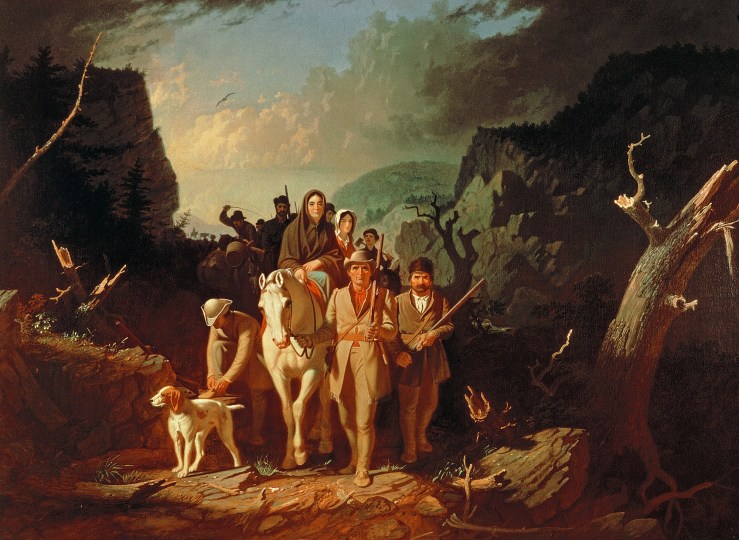
PHD29102

Among those to whom Finley related the thrilling story of his visit to this hitherto unexplored region, was a man, whose life is identified with the early history of Kentucky, and whose name shines conspicuous among the pioneers of the west. For bold enterprise and lofty daring; for unfaltering courage and utter contempt of danger; for firmness of purpose and coolness of execution; for all the qualities necessary for a successful pioneer, few men deserve to rank higher than Daniel Boone. He was the very man for the emergency. His soul was fired with the prospect opened to him by the relation of Finley; and he entered upon the new career which lay before him, with all the ardour of his soul – an ardour which was however qualified by the cool determination to do or to die.

On the first day of May, 1769, Daniel Boone, accompanied by John Finley, John Stewart and three others, left his residence on the Yadkin river, in North Carolina, with the determination to explore Kentucky. On the 7th of June, he reached Red river, a branch of the Kentucky river. From an eminence, he descried the beautiful level of Kentucky, about Lexington; and his soul was charmed with the prospect. He represents the whole country as swarming with buffalo, deer, elk, and all kinds of game, and filled with wild beasts. He continued hunting with his companions until the 22nd of December, soon after which John Stewart was killed by the Indians; the first white man known to have fallen by their hands in Kentucky. His comrades, probably alarmed by this circumstance, returned to their homes in North Carolina; but Daniel Boone, with his brother who had lately come out, remained in Kentucky during the winter. He pitched his camp on a creek in the present Estill county, called, from this circumstance, Station Camp Creek. Here he continued until the following May, undisturbed by the Indians, who seldom visited Kentucky in the winter.[9] He then returned to his friends on Yadkin river.

In this same year, 1769, Col, James Knox led out a party of about forty hunters through the unexplored regions of Tennessee and Kentucky. In Kentucky, nine of this party penetrated as far as the Green and Cumberland rivers, and were designated “the Long Hunters,” from the length of time they were absent from their homes.[10]

The bounty lands awarded by the British government to those who had served in the war against the French, furnished another keen incentive to emigration. For, though the royal proclamation granting the bounty, forbade that the lands should be laid off on the Ohio river, yet its prohibition was disregarded. Surveyors, employed by the claimants of these bounty lands, penetrated to all parts of Kentucky. The most conspicuous of these land surveyors were Thomas Bullit and Hancock Taylor, who came out to Kentucky from Virginia in 1773. On their route they were overtaken  by the M’Afees, whose names are so closely connected with the history of the early settlement of our State.[11] Bullit was elected Captain of the party, which proceeded  to mark off the site of the present city of Louisville, in August, 1773.

During the same year, James Douglass, another surveyor, visited Kentucky. He was the first man who discovered the celebrated collection of mammoth bones, in the place known since by the name Big Bone Lick. “Douglass formed his tent poles of the ribs of some of the enormous animals, which formerly frequented this remarkable spot, and on these ribs blankets were stretched for a shelter from the sun and the rain. Many teeth were from eight to nine. And some ten feet in length; one in particular was fastened in a perpendicular direction in the clay and mud, with the end six feet above the surface of the ground; an effort was made by six men in vain to extract it from its mortise. The lick extended to about ten acres of land, bare of timber, and of grass or herbage; much trodden, eaten, and depressed below the original surface, with here and there a knob remaining to show its former elevation.”[12]
fixedw_large_4x

About the year 1774, another surveyor, Simon Kenton, with two companions, landed a few miles above Maysville, or Limestone, as it was then called. This party penetrated to May’s Lick, and visited the Upper and Lower Blue Licks. They saw immense herds of Buffalo, in the vicinity of the licks. On returning to his camp, near May’s Lick, from one of his exploring expeditions, Kenton found it sacked and burned by the Indians; and, at a little distance from it, he discovered the mangled remains of Hendricks, one of his companions, who had been tied to a stake and burned. He was the first and the last white man who suffered this cruel manner of death at the hands of the Indians on the soil of Kentucky.[13]

The parties who had hitherto visited Kentucky were either hunters, land surveyors, or mere adventurers. No attempt had as yet been made to settle down on the soil and to establish regular colonies. On the 25th of September, 1773, Daniel Boone attempted to remove five families to Kentucky, with a view to their permanent location in the territory which he had already explored. But he had not advanced far when, according to his own account, “the rear of his company was attacked by Indians, who killed six men and wounded one.”[14] The party returned to their homes, in North Carolina, and the attempt was given over for the present.

Another hardy adventurer from Virginia, was more fortunate. James Harrod came out to Kentucky with several families, in the year 1774. He built the first log cabin in Kentucky, on the site of the present town of Harrodsburgh, then called Harrod’s Town. This colony was soon dispersed by the Indians; but, after a brief interval, it was re-established under more favorable auspices.[15]

Early in 1775, Daniel Boone again visited Kentucky, in the capacity of guide to a party sent out by the Henderson Land Company, which had purchased the Cherokee title to all the lands south of the Kentucky river. The party was often attacked by the Indians, but finally succeeded in reaching the Kentucky river.  To protect themselves from Indian invasion, they immediately set about erecting a fort, which was called Boonesborough.  It was commenced on the 1st of April of that year, and completed on the 14th of June following. This was the first fort erected in Kentucky. It consisted of a stockade, with block houses at the four angles of the quadrangular inclosure.[16]

The next fort erected was that at Harrod’s Town. The colony in the vicinity of this place had been greatly strengthened by a party led out from North Carolina, by Hugh McGary, in the fall of 1775. At Powell’s valley he had united his party to another conducted by Daniel Boone; and the whole body numbered twenty-seven guns, or fighting men, besides women and children. The parties again divided on reaching Dick’s river; that under Boone repairing to Boonesborough, and that under McGary, to Harrod’s Town. The fort in this latter place was commenced in the winter of 1775-6.[17]

Whenever a colony was planted, there a fort was also erected, as a protection against the Indians. They were called Stations. These multiplied in proportion as the new territory became settled. The principal and most ancient of them, besides those already named, were: Logan’s Station, established by Col. Benjamin Logan, about the same year as that at Harrod’s Town, at the distance of one mile from the present town of Stanford, in Lincoln county; Floyd’s Station, on Beargrass Creek, about six miles from Louisville, and another in Lexington.

Many were the difficulties and terrible the dangers encountered by the first emigrants to Kentucky. They carried their lives in their hands: the Indians gave them no rest day or night. From the date of the first settlement in 1774, to that of Wayne’s decisive victory and the subsequent treaty of Greenville, in 1795 – a period of twenty-one years – Kentucky was a continued battle-ground between the whites and the Indians, the latter ceaselessly endeavoring to break up the colonies, and the former struggling to maintain their position. The savages viewed with an evil eye the encroachment on their favourite hunting grounds, and employed every effort to dislodge the new comers. To effect their purpose, they resorted to every means of stratagem and of open warfare. Their principal efforts were, however, directed against the forts, which they rightly viewed as rallying points of the emigrants. For nearly four years they besieged, at brief intervals, the forts of Harrod’s Town and Boonesborough, especially the former, which they made almost superhuman exertion to break up.

The colonists were often reduced to the greatest straits. Their provisions were exhausted, and all means of obtaining a new supply seemed hopelessly cut off. Their chief resource lay in the game with which the forests abounded. But hunting was hazardous in the extreme, while their wily enemies lay in ambush in the vicinity of the forts. The hunters were often shot down, or dragged into a dreadful captivity, with the prospect of being burned at the stake, staring them in the face. Did they attempt to cultivate the soil, the husbandmen were often attacked by the Indians. The labourers in the field were under the necessity of being constantly armed: they were generally divided into two parties, one of which kept guard, while the other cultivated the soil. But during the four years’ siege, above referred to, even this method of tilling the land became too hazardous, and was, at least to a great extent, abandoned.

Besides, their ammunition was often exhausted, and the obtaining of a new supply was extremely difficult and dangerous. The road to the old settlements lay through a wilderness beset with lurking savages. All these difficulties taken together, became truly appalling. Still the hardy pioneers were not cast down. They were struggling for their new homes, for their families, for their very existence. Prodigies of valour were achieved by individuals, and by small parties, to detail which would greatly exceed the limits of this brief summary.[18] It was the heroic age of Kentucky.
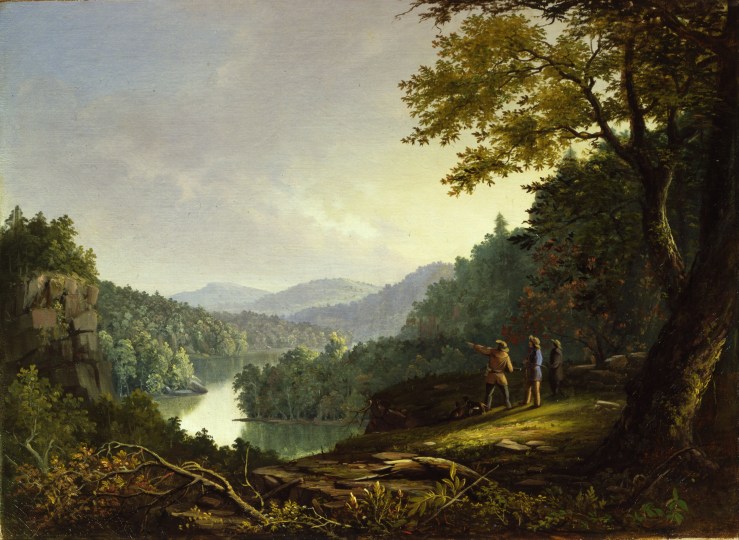
James_Pierce_Barton_-_Kentucky_Landscape_-_1832_-_Google_Art_Project

But the rude military tactics of the savage could not cope with the superior organization and higher civilization of the white man. Succours continued to pour into the stations, from Virginia, North Carolina and Maryland, in spite of all Indian opposition. In 1775, there arrived in Harrod’s Town a man who was destined to exercise a powerful influence on the rising destinies of Kentucky and of the whole west. James Rogers Clark was a native of Virginia, whence he emigrated to join the bands of hardy adventurers who were seeking their fortunes in the west. He was young, bold, and adventurous; was active in body and mind; and was gifted with great coolness, forecast, and military talent.

In the fall of the year, 1775, Clark returned to Virginia, but he revisited Harrod’s Town in the following spring. A meeting of the citizens was held, and he and Gabriel John Jones were ap-pointed delegates to the legislature of Virginia. They succeeded in obtaining from the Governor and Council of that Commonwealth a loan of 500 pounds of gunpowder, which Clark was charged to transport to Harrod’s Town. Clark executed this difficult commission with wonderful intrepidity and success. After having been pursued through almost the entire journey by the Indians, who compelled him to conceal the gunpowder for some time near Maysville, or Limestone, he finally succeeded in delivering it safely at Harrod’s Town. The drooping spirits of the garrison rallied on receiving this most fortunate supply, which, had it fallen into the hands of their enemies, would have been employed for their destruction.

The active mind of Clark soon led him to the conviction, that unless some decisive blow were struck, the infant colonies could not hope long to struggle successfully against their savage invaders. He determined to carry the war into the heart of their own territory, and to wrest, if possible, from the hands of the British the military stations of Kaskaskias and St. Vincents, or Post Vincennes. These his quick eye soon discovered were the great rallying points of the Indian invaders. Accordingly, he obtained a Colonel’s commission from the Commonwealth of Vir-ginia, with men and military supplies for the expedition: The commission was dated January 2nd, 1778. It was drawn up by Patrick Henry, the Governor of Virginia, who gave Colonel Clark two sets of instructions: one public, ordering him to repair to Kentucky for its defence; and the other private, directing an attack on the British Post of Kaskaskias. The war of the Revolution was then raging; and the success or failure of Clark’s expedition was destined to have an im-portant bearing on the question, whether Great Britain or the United States should be able to claim the proprietorship of the northwest.

Col. Clark showed by his conduct that the confidence reposed in him was not ill-placed. He conducted the expedition with singular prudence and secrecy. He landed his small army near fort Massac, on the Ohio river; marched through Illinois; and, on the fourth of July, 1778, he took Kaskaskias by surprise, without shedding a drop of blood! On the sixth of July, he detached Col. Bowman with a company of men, who surprised and captured the neighbouring military post of Cahokias.[19]

Col. Clark determined to follow up the advantages thus secured. After a long and painful march through Illinois, in the most inclement season of the year, he appeared, on the 23rd of February, 1779, with 170  men, before Post St. Vincent’s, on the Wabash, then also in possession of the British. He compelled the British commandant, Hamilton, to surrender at discretion, after a slight previous skirmishing.* Thus, were the British driven from the northwest, by a mere handful of men, under a gallant and skillful commander. And thus also were the great centres of Indian invasion broken up.

Still., notwithstanding this terrible blow struck in the strongest rallying points of the northwest, the Indians, especially the Miamis and the Shawnese, continued to carry on the war with unabated fury, against the white settlers of Kentucky. They united their forces at Chilicothe, and determined to strike one more blow for the recovery of their favourite hunting grounds, which they beheld fast escaping from their grasp.

On the 14th of August, 1782, an army of about 500 warriors suddenly appeared before Bryant’s Station, twelve miles from Lexington. So cautious had been their movements, that they made their appearance in the very heart of Kentucky without exciting any alarm. They closely encompassed the place, killing or driving away the cattle and horses, and shooting down or taking prisoners chance stragglers from the station. The siege continued for only two days; for happily on the first appearance of the savages, a few intrepid men had escaped, who carried the alarm to the neighbouring stations of Lexington, Boonesborough, and Harrod’s Town; and also to Logan’s Station. So prompt were the movements of the men in these stations, for the succor of their brethren, that on the 18th of August, a force of 182 chosen men from Lexington, Boonesborough, and Harrod’s Town, assembled at Bryant’s Station. The Indians, anticipating, or cognizant of this movement, had already fled. They were hotly pursued to the Lower Blue Licks, a distance of about 40 miles, where they were speedily overtaken. Daniel Boone and some other officers, fearing an ambuscade, endeavored to check the ardour of the pursuit, in order to await the arrival of reinforcements under Col. Benjamin Logan from Logan’s Station. But this wise course was prevented by the imprudent impetuosity of Major Hugh M’Gary, who, plunging his horse into the Licking river, cried out, with a loud voice, that “all who were not cowards should follow him, and he would show them where the Indians were.”
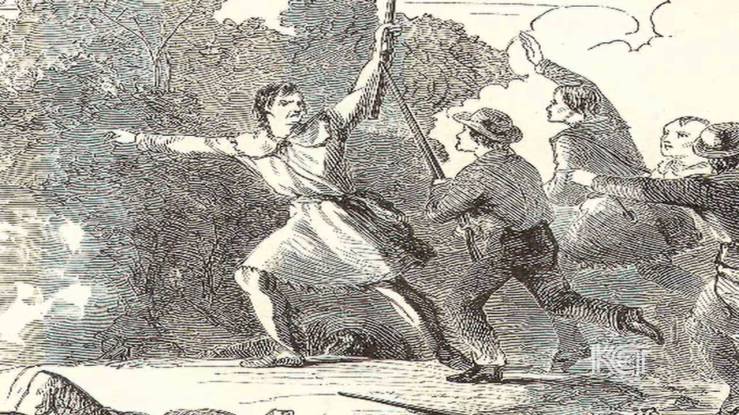
maxresdefault

The whole body of the pursuers shared in his impetuosity, and followed after him in disorder. But they had not advanced more than a mile, when they received, throughout their whole front line, a murderous volley from the Indians, who lay concealed in a deep ravine, extending on both sides of the road at right angles to it. The ranks of the white men were thrown into confusion, and, though they fought with desperation, could not withstand the assault for more than a few minutes. They fled precipitately, the Indians following them with loud shouts and uplifted tomahawks. Many were killed in the attempt to re-cross Licking river. The route was complete, and the Indians pursued them for many miles, killing or taking prisoners the straggling parties whom they were able to overtake.

Never, in the whole annals of Indian warfare in Kentucky, had the white people experienced so overwhelming a defeat. Besides the wounded, about sixty of them were killed, and seven taken prisoners; most of them from Harrod’s Station. Among those slain were Col. Todd from Lexington, and Majors Trigg, McBride, and Harland, from Harrod’s Town. Major M’Gary escaped. [20]

Shortly after the action, Col. Benjamin Logan reached the battle ground with 450 chosen men; but only in time to bury the mangled bodies of the dead. The Indians had already fled into the interior of Ohio. Had the pursuing army patiently awaited his arrival, the disastrous defeat of the Blue Licks might have never occurred. But petty jealousies among the officers, and their desire to win the laurels of victory without the presence and assistance of their senior officer, Col. Logan, prevented their taking the prudent advice of Daniel Boone: and bitterly did they rue their rashness, when it was too late.[21]

In the midst of the despondency occasioned by this ruinous defeat, all eyes were turned on Col. James Rogers Clark, who had recently been promoted to the rank of General. He immediately called a meeting of the superior officers, at the Falls of the Ohio river; and it was unanimously resolved to organize a large body of mounted riflemen, for the pupose of attacking the Indian towns in the interior of Ohio,

On the last day of September, 1782, 1000 mounted riflemen appeared at the appointed place of rendezvous, the mouth of Licking river, under the command of Cols. Floyd and Logan, who were the officers next in rank to General Clark. The expedition proceeded with great secrecy to the neighborhood of Chilicothe. But some Indian stragglers had already communicated the alarm; and on the approach of the army, the Indian towns were found already evacuated. The expedition was enabled only to burn the towns and to destroy the Indian crops; after which the soldiers returned to their respective stations in Kentucky.[22]

Not withstanding the constant attacks of the savages, and all the horrors of Indian warfare, the white population continued to pour into Kentucky. But seven years had elapsed since the first attempt to colonize the country, and already, with tempt to colonize the country, and already, with little more than a month’s warning, the infant colonies could send into the field 1000 mounted men. The white population continued to increase so rapidly, that in less than ten years from the date of the battle of the Blue Licks, Kentucky, which had hitherto been a mere county dependent on Virginia, was strong enough to claim admission into the Union, as a separate State. The application was first made in 1790; but the convention of deligates for framing the new State Constitution was able to close its labours only on the first of June, 1792. At this latter date Kentucky was recognized as an independent Commonwealth.[23] She was the first addition to the venerable thirteen, who had gloriously fought the battles of Independence.

This war had come to a triumphant termination in 1782 – the same year that the battle of the Blue Licks was fought. The United States, now freed from all the apprehensions from a foreign foe. Had time to breathe, and to devise measures for the protection of the west from the Indian invasion. In the year 1790, the United States government commissioned General Harmar, with 329 regular troops under his command, to prosecute the Indian war in the northwest. In the west, his army was joined by a much larger body of militia and volunteers; and the expedition marched from Fort Washington – the site of the present city of Cincinnati – on the 30th of Sept. 1790. The Miamis were the first objects of attack.

But General Harmar was unskilled in the tactics of Indian warfare; and he was too confident in his own opinions to listen to the advice of his western subalterns in command. He proceeded against the Indians according to the rules of regular warfare. The savages outgeneralled him, and his expedition turned out a complete failure. After a few month’s campaign, the troops under his command returned to Fort Washington, without having effected anything, except the destruction of the Indian towns and provisions.[24] In this expedition col. Hardin from Kentucky signalized his bravery in many sharp skirmishes with parties of the Indians.

On the failure of General Harmar’s expedition, the veteran, Gen’l. Arthur St. Clair, was appointed to the command of the American army of operations against the Indians. He had fought bravely in the war of the Revolution; but was now old and infirm. So far was he disabled, in fact, that he was carried on the march in a litter. He had under his command about 3000 men, nearly half of whom were regulars. He marched in good order to the Indian towns: but on the memorable 4th of November, 1791, his army was suddenly attacked and defeated, with dreadful slaughter, by the Miamis. His troops were completely routed, and the retreat was a precipitate flight. Many of the soldiers threw away their arms; and the army left in the hands of the Indians their baggage, artillery, and munitions of war. So disastrous a defeat had never yet occurred in the annals of Indian warfare in the west.[25]

So far the Indians had triumphed, even over the regular forces of the United States. They clung with tenacity to the cherished tombs of their fathers; and were prepared to resist to the utmost all attempts of the white man to encroach on their territory. Can any one blame them for thus gallantly defending their own lands and firesides?

A deep gloom overspread the frontier settlements of the west. All were alarmed at the prospect of a dreadful Indian invasion, with its attendant horrors. The terrible war-whoop seemed already to ring in their ears: and the fond mother pressed her infant more warmly to her bosom, as she reflected that perhaps on the morrow its brains might be dashed out by the ruthless savage, and her own head scalped or riven by the knife or tomahawk. The long years of bitter struggle with the Indians had proved, that these terrors were not wholly without foundation.

In this emergency, the United States government at length selected a man who was adequate to the undertaking of putting an end to the Indian war, and of thus effectually protecting the western settlements. Gen’l. Anthony Wayne, an officer of the Revolution, combined great coolness of purpose with that impetuosity of bravery, which had already obtained for him the soubriquet of “Mad Anthony.”

This brave and experienced officer marched during the winter of 1793, to the scene of Gen’l. St. Clair’s disastrous defeat. He re-occupied it, and on its site erected a fort, which he called Fort Recovery. In the summer of 1794 he was joined by about 1600 Kentucky volunteers, under Gen’l. Scott: and he then found himself in command of about 3200 troops, one half of whom were regulars. He was unremitting in his labors, to train his army to all the subtle tactics of Indian warfare. He caused them to sleep on their arms; and during the night, he often had them aroused by feigned surprises from the Indians. The troops were thus schooled to the vicissitudes of an Indian campaign.

After having sufficiently trained his men, and engaged in several skirmishes with the savages, he marched his forces to the principal Indian settlements, at the confluence of the Au Glaize and Maumee rivers. Here he attempted a surprise, but without effect, the Indians having already fled. He continued his march to the rapids of Maumee, where, on the 20th of August, 1794, he encountered the whole Indian force. A great and decisive engagement ensued, which, after a short contest, resulted in a complete victory for the Americans. The power of the Indians was broken overwhelmingly, and, as the event proved, for ever.[26]
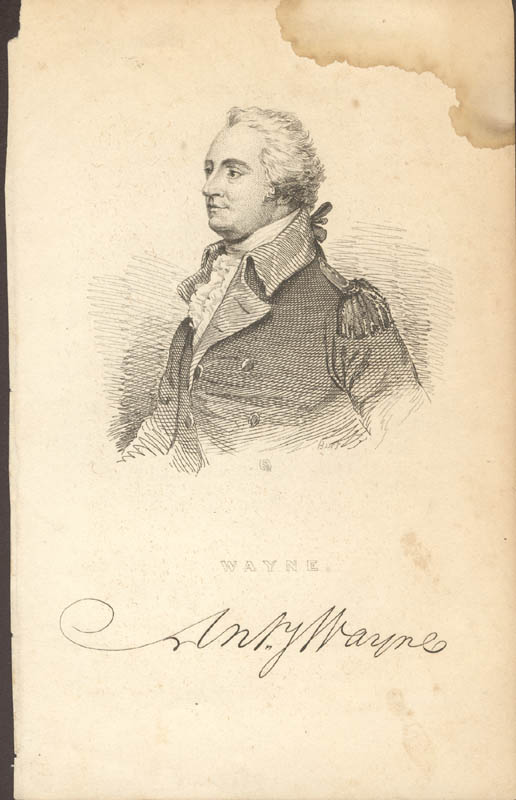
182416

In the following year, 1795, the great Treaty of Greenville secured a permanent peace between the Indians and the white men, and protected the latter from all fear of further invasion. After this treaty, the Indians made a few more struggles for their territory, which they beheld fast escaping from their hands. They sullenly yielded to their fate, and gradually melted away, before the march of civilization,(!) leaving the graves of their fathers behind them. Thus terminated the Indian border wars of the northwest.

[1] The former in 2 vols. 8vo.; and the latter in 1 vol. 12 mo. The edition of Marshall, to which reference may be made in the sequel, is that of Frankfort, 1824: and of Butler, that of Louisville, 1834.

[2] In the beginning of his first volume (pg. 13, seqq.,) Mr. Marshall indulges in a long and somewhat rhapsodical account of the Indian “annals of Kentucky;” Noah’s flood being the fifth period of his annals!! This is one way to write history!

[3] Thatcher’s “Lives of the Indians,” (P.39) quoted by Butlet, p.2 Edit. Louisville, 1834

[4]  Report of Administration of British Colobies – apud. Butler p.3

[5[ Franklin’s Works, vol, iv. p. 271.,

[6] Butler, p. 4

[7] In his reports to Sec’ry. Armstrong, 1814. Amer. State papers.

[8] The present county of Henderson is a portion of this territory.

[9] See Boone’s Narrative, written from his dictation, by John Filson, in 1784: and Butler, p. 18. Seqq.

[10] Butler,pp. 18-19.

[11] For an interesting account of the adventures of the M’Afees, in Kentucky, see Butler,  p. 22. Segg. His account is drawn from the M’Afee papers, to which he had access.

[12] Butler, p. 22.

[13] Butler, p. 23-4.

[14] Id. p. 29.

[15] Id. p. 26.

[16] Id. p. 27.

[17] Id. p. 29. seq.

[18] We refer those who may wish to see more on this interesting subject, to the two histories of Kentucky above named.

[19] We have condensed the detailed statement of Butler, derived from the papers of Gen’l. Clark. p. 48. Seqq

[20] For a full account of this remarkable expedition, see Butler, p. 81. seqq.; and for a more detailed and interesting one still, see Judge Law’s able discourse, delivered before the “Vincennes Historical Society,” on the 22nd of Feb. 1839, p. 31. seqq.

[21] See, for a more detailed account of this battle, Butler, p. 125. seqq.

[22] Id. p. 131. seqq.

[23] Id. p. 211.

[24] Butler,  p. 191. seqq.

[25] Id. p. 203. seqq.

[26] Butler, p. 235. seqq.

SKETCHES OF THE EARLY CATHOLIC MISSIONS OF KENTUCKY; FROM THEIR COMMENCEMENT IN 1787, TO THE JUBILEE OF 1826-7

EMBRACING A SUMMARY OF THE EARLY HISTORY OF THE STATE; THE ADVENTURES OF THE FIRST CATHOLIC EMIGRANTS; BIOGRAPHICAL NOTICES OF THE EARLY MISSIONARIES; THE EARLY HISTORY OF THE PRINCIPAL PROTESTANT SECTS IN KENTUCKY; WITH SOME ACCOUNT OF THE ESTABLISHMENT OF THE EPISCOPAL SEE AT BARDSTOWN, OF THE VARIOUS RELIGIOUS SOCIETIES, AND OF THE GENERAL STATE OF THE CATHOLIC RELIGION IN KENTUCKY.

COMPILED FROM AUTHENTIC SOURCES, WITH THE ASSITANCE OF

THE VERY REV. STEPHEN THEODORE BADIN

THE FIRST PREIST ORDAINED IN THE UNITED STATES.

BY M. J. SPALDING, D. D.

________

Colligite fragmenta quo manet, ne percant.

Gather up the fragments that remain, lest they be lost. – St. John vi. 12.

________

LOUISVILLE:

  1. J. WEBB & BROTHER.

JOHN MURPHY, – BALTIMORE.


TO THE

Rt. Rev. Benedict Joseph Flaget, D. D.

BISHOP OF LOUISVILLE,

And the Venerable Patriarch of the West,

THESE SKETCHES OF A HISTORY,

IN WHICH HE WAS A PRINCIPAL ACTOR,

AND OF WHICH HE WAS THE BRIGHTEST ORNAMENT,

Are Respectfully Inscribed,

AS SOME SLIGHT TRIBUTE TO HIS MANY EMINENT VIRTUES,

AND TO HIS PROTRACTED APOSTOLICAL LABORS IN KENTUCKY,

AND AS A SMALL PLEDGE OF GRATITUDE

FOR HIS PARENTAL SOLICITUDE,

AND FOR HIS MANY ACTS OF AFFECTIONATE KINDNESS,

BY HIS FAITHFUL SERVANT,

AND GRATEFUL CHILD IN CHRIST.

                                                                                    THE AUTHOR.     

PREFACE

~~~~~~~~~~~~

The writer of the following pages has not intended to give a full and connected history of the early Catholic Missions in Kentucky. His only object has been, to collect together, and to record, in a series of sketches, such facts as might prove interesting to the general reader, and serve as materials for the future church historian of the United States, and especially of the West, to which Kentucky has been, in a religious, if not in a political, point of view, the great pioneer and alma mater.

Of all the Western States Kentucky is the oldest; and it was this State, that the first Episcopal See of the West was erected. At the time of its establishment, the See of Bardstown held spiritual jurisdiction over all the States and Territories of the United States, lying between the thirty-fifth degree of the North Latitude and the lakes of the North, and between the States bordering on the Atlantic Ocean and the Rocky Mountains. This vast original diocese of the West is now divided into ten different flourishing dioceses, under ten different prelates, all of whom look up to the venerable Bishop Flaget as their Patriarch.

Most of the early Catholic settlers of Kentucky, and almost all the older missionaries, have already disappeared from the stage of life; and the scanty remnant of these venerable pioneers is now fast hastening to the tomb. They belonged to a class; which did much, and wrote little. The dangers and hardships, through which they had to pass, left them little time; and gave them little inclination, to write their memoirs. Almost the only means of learning the early religious history of Kentucky, of which their lives constitute the principal part, is to take down their own statements of facts, and their own reminiscences of early times, while they still linger above the horizon of life.

This is what the writer of these hasty and imperfect sketches has attempted to do. How well he has succeeded the public will best judge. The only merit he can claim is that of some industry and patient research. He has sought information from almost every living source within his reach; he has noted down, and compared with one another the different statements of numerous aged persons; he has labored to supply the deficiencies, or to correct the mistakes, of some of the statements, by the more copious or accurate details furnished by others: in a word, he has endeavored to derive from all of them an accurate, and, as far as was practicable, a connected account of the early Catholic Missions of Kentucky.

But he did not stop here. He endeavoured to examine all the written and printed documents, bearing on the subject, to which he could have access. The statements furnished by these papers, were diligently compared with those contained in the notes of the oral accounts just alluded to: and the comparison served to shed additional light upon both.

The published accounts of our early missions, besides being, in general, unconnected and fragmentary, are meager enough. Scattered over the pages of the many volumes compromising the “Annals of the French Association for the propagation of the Faith,” or published in various religious journals of Europe and America, they are sometimes inaccurate in point of facts and dates. Some of them are overburdened with unimportant details, too trivial for history; while others by far the most valuable – are much too brief and summary. To the former class belong many of the letters written by our early missionaries; to the latter, a few succinct and well-written accounts of our early missions.

To this class belongs the admirable account of the early missions of Kentucky drawn up by the very Rev. M. Badin, while residing in Paris, in 1822. This sketch has good qualities of nearly all the other writings of the venerable ‘first-ordained” of the United States. It is clear, connected, accurate in point of facts and dates, well written, and in good taste. The only matter of regret is, that it is so brief, and that it enters into so few details. Yet, withal, it has been found of great utility in the composition of the following sketches, which have in fact, been based on it, at least, in that portion of the early religious history of Kentucky of which it professes to treat.

The author deeply regrets, that this is almost the only writing of M. Badin to which he could have access. In the numerous peregrinations and wanderings of this venerable missionary pioneer, most of his notes and papers, connected with his early labors in the west, have been entirely lost.* Yet the writer of these sketches has derived invaluable assistance from him otherwise. In fact, it was he who, in a great measure, originated the work, which would not probably have been undertaken, but for his promised aid and co-operation. His clear memory of facts and dates furnished much valuable information on the earlier portion of our missionary history; and supplied many of the links that were wanting in the chain of printed documents.

The later portion of our religious history, comprised in these sketches, might have been much more copious and detailed, had another venerable personage not been prevented by his modesty and humility from allowing the writer access to his copious notes and papers. However much this may be regretted, it may, perhaps, be thought that the time had not yet come for writing this portion of our missionary history. When that time shall come, the necessary materials will probably not be wanting; nor will they be deficient, either in copiousness, or in interest.

One of the greatest difficulties, perhaps, which the writer of these pages had to encounter, arose from his having undertaken to write the history of recent events, many of the actors in which are still living. If it is a difficult and delicate task to write the history even of the dead; it is manifestly much more so, to write that of the living. A man’s actions and motives cannot be properly appreciated, until after he has completed his career, and finished all the acts in the drama of life. Influenced by these considerations, the author has determined to say as little as possible of the living, and to confine himself almost entirely to the dead. He has however felt compelled to make two exceptions to this rule; and to speak at some length of two venerable living octogenarians, without an account of whose lives and labors, any history of the early missions of Kentucky would be meagre and incomplete indeed.

The chief thing aimed at by the author has been accuracy in facts and dates. He is, however, sensible that, from the difficulties he had to encounter in regard to the materials of the history, as well as from numerous interruptions by heavy missionary duties while engaged in writing it out, he may have been betrayed into some errors. These he will willingly correct, whenever they will be pointed out by any kind friend. To enable his readers the more easily, to know the sources whence he borrowed his information, he has also thought it better to indicate his authorities as he proceeded.

To such as might be included to think, that many incidents and anecdotes related in these pages are too trivial in their character, and had better have been omitted, he would beg leave to say, that these things may have a local, if not a general interest; and that many details, which would be wholly out of place in a regular history, may be pardoned in more desultory sketches.

BARDSTOWN, KENTUCKY

Feast of Corpus Christi, 1844

* This loss occurred chiefly while he was laboring among the Potwatomy Indians of the North west, about twelve years ag

o.b33