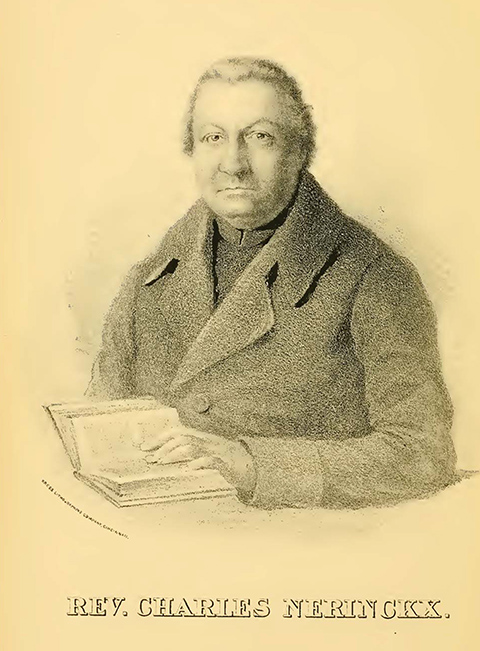
There are all kinds of accolades and praises I could sing of Charles Nerinckx. The churches he erected, the founding of the Sisters of Loretto, the dangers he didn’t let stop him from ministering in the wilderness, his devotion the Blessed Mother and the confraternities he established in her name, the humble refusal of his appointment as bishop of New Orleans so he could continue in this missionary field, and so much more. We will start though with the one thing he was sure to teach everyone he met:
“Do not forsake Providence and He will never forsake you!”
Charles Nerinckx was born October 2, 1761 in Belgium. He was the oldest of 14 children whose father was a doctor and mother a valiant woman of great faith.
The family boasts of many vocations. Charles had an uncle who was a priest, an aunt who was a Benedictine nun and another aunt, Mother Constantia Langendries, who was the superior of the Hospital of Saint Blasé.
And Charles’ generation did not disappoint in vocations – besides Charles, Peter Joseph, the second oldest born in 1763, joined the Brothers of Charity and died a member of that congregation in 1796.
John Henry born in 1776, was only 15 years old when he became a novice in the Capuchin Convent. Before he could make his final vows the convent was scattered by the agents of the French Revolution. See, the revolution was not confined to just France.
John Henry lived with his brother for a bit at the parsonage of Everberg Meerbeke, where Charles was the pastor. The parish was taking their annual pilgrimage to Our Lady of Scherpenheuvel on October 21st, 1797. Charles was sick so John Henry thought he could safely take his place and not risk his freedom. But the blood hounds of the Revolution had not lost his scent and had been looking for an opportunity to arrest him. That night John Henry was imprisoned in the Treurenberg (True en berg) dungeon near Brussels. He was then sent to St. Maurice’s prison in France and then to the penal colony of Cayenne, with 34 priests and clergy in 1798. He looked for a chance and made his escape from the prison.
After a year of eluding the authorities he reached the English colony of Berbis and was able to secure passage on a frigate to Liverpool, along with his six companions – the only survivors of the 34 exiles.
John Henry was ordained in England and served there the remainder of his life. His sister, Mary Ann, and him, established schools under the Society of Faithful Companions of Jesus.
He died in England at the young age of 84.
Mary Catherine, born 1768, Jane Constance, 1770 and Mary Ann born 1773, all belonged to the same Order of Citeaux and were all forcibly ejected from their monasteries by the Revolution.
So you see how the French Revolution affected the entire family but also how secure they were in their faith, and ready to sacrifice to hold on to it.
The young Charles was ordained to the priesthood in 1785 and appointed Vicar of the Metropolitan parish of Saint Rumoldus in Mechlin. Here his zeal for the salvation of souls and for the instruction of the poorer classes, whose interests were mostly ignored and neglected by the clergy in the larger cities.
The young priest drew the attention of the venerable Prince John Henry Cardinal de Frankenbergh, the Archbishop of Mechlin and stimulated by the paternal encouragement of the prelate, Father Nerinckx soon beheld his generous efforts crowned with abundant fruits. He felt amply repaid for his pains when he witnessed the poor that he ministered to, better instructed in their Christian faith and duties, and more satisfied with their lives, fill to overflowing the vast cathedral church where he celebrated Mass for them on early Sunday morning.
Every Sunday he preached to them in earnest and simple words, better suite to the intellect of his hearers, than the flowing oratorical efforts which, at that period, constituted the pulpit eloquence of the day. He remained in this position for eight years. From there he was appointed pastor of Everberg-Meerbeke.
The parish of Everberg-Meerbeke was situated midway between Brussels and Mechlin and was in a sad state of disorder when he took charge in 1794. People were lukewarm in their religious duties and many had lost their faith
Okay, I have to put the paragraph in just as it was written in 1879 by Bishop Maes of Detroit.
The rationalistic teachings of the last century had caused a singular falling off in the number of ecclesiastical vocations. Hence, men who in the common order of things, had a long-standing right to an honorable rest in their old age, were left in the ministry to administer, as best they could, to the spiritual wants of the people committed to their care. Having lost the necessary vigor of mind, and, for the greater part, afflicted with bodily infirmities, the natural consequences of old age, these poor priests often died brokenhearted, because unable to attend to their duties, and held responsible for the evils attending their unwilling neglect. The disastrous effects of this state of affairs were soon apparent all over the land. People grew lukewarm in their religious duties; many lost the faith; and the nation was soon ripe for that stupendous French Revolution, true deluge of impiety and socialism, that astonished all but those who knew what inroads irreligion had made, and rendered every man in the land, either a horrified victim or a bloodthirsty criminal.
This is exactly the case of Everberg-Meerbeke. The old age of the late pastor had long rendered him unable to uphold the duties of his office. The church was dilapidated, and the parishioners were obviously in spiritual neglect. The state of this parish would have discouraged any young priest, except for that force of character and indomitable energy of Father Nerinckx.
He went to work at once. Knowing the best to get the good will of the parents was to gain the love of the little ones. He urged the parents to send their children to church so he may get acquainted with them. The interest manifested by this new pastor for the welfare of the children could not but flatter the parents nand they brought them to church.
The children soon loved their new spiritual father and brought home glowing accounts of the religion they were learning and the stories that he told to guide them. Soon he had established regular catechetical instructions, employing both young men and women to aid him. In a few years there was not a better instructed people in the Archdiocese.
The children grew up “in age and wisdom before God and men” and their eagerness to come to Bible study brought many a hardened parent back to the dilapidated church. The parish of Everberg-Meerbeke which a few years earlier had been pointed at as a perfect Bedlam of disorder and irreligion, became a model for imitation to all.
The parish at Everberg-Meerbeke was on it’s way to a total reformation! The good priest established processions in honor of the Blessed Sacrament and of the Blessed Virgin which fostered public devotion and unrestrained exterior expression. To enable all to preform the works of Christian charity, confraternities were established to visit the sick, pray for the dead, etc.
As a natural consequence, the atheistic teachings of the French revolutionists, whose armies had recently invaded Belgium and were everywhere spreading the irreligious spirit of their government, found little favor in the now thoroughly Catholic village of Everberg-Meerbeke. The pious priest became an object of suspicion to the revolutionary rulers.
Ignoring severe prohibitory laws, he fearlessly fulfilled his duties as pastor, until after having said Mass and publicly assisting at a funeral, without previously taking the blasphemous oath required of all priests who wished to retain their position, an order was issued for his arrest in 1797. This ultimately put an end to his good work at Everberg-Meerbeke after only 3 years.
However, Father Nerinckx had the heart and was in the hearts of his parishioners, who one and all were anxious for his safety. They gave him timely warnings to elude the officers sent to arrest him and enabled him to avoid the fate which befell his brother John and so many other clergy.
Dressed in shabby peasant clothes, the good priest fled by little used paths in the dead of the night to Dendermonde. He arrived on August 6th 1797 mat the Hospital of Saint Blasé where, if you recall from earlier, his aunt was the superior.
The chaplain of the hospital had been arrested a few weeks earlier and exiled to the penal colony of the Isle of Rhe. The nuns found the occasion to notify the Bishop of Ghent of the arrival of the persecuted priest and he not only gsve leave, but requested that father Nerinckx urgently attend to the spiritual wants of the community of nuns and the many sick entrusted to their care.
Trusting that he was where God wanted him, and resolved to await the result of the warfare that the powers of Hell were waging against his faith, Father Nerinckx set to work in his usual energy and his ministry bore much fruit.
He not only led the community in their instruction and celebration of the sacraments, he also faithfully attended the sick and wounded who were crowded into the halls of the hospital. He usually spent the whole night consoling the suffering and administering the last rites to those in danger of death and then devoutly prepared for the holy Sacrifice of the Mass which he said for the community at 2 AM.
After Mass he visited the wounded prisoners from the revolutionary battles that were shut up in the hospital. He tried to ease their suffering while giving them spiritual support. The priest brought the sacraments to those unfortunate victims of war who were to be executed the next day and assured them that he would be at the window of his hiding place to impart to them once more sacramental absolution.
The prisoners would be hurried along the streets in chains like murderers, to howls of an angry mob and pushed along with the butt-ends of the soldiers’ guns. The poor fellows would cast a glance where they knew Father Nerinckx was watching them, and bow their heads in a sign of contrition and gratitude, all the while the consoling words of forgiveness were silently wafting over the heads of the crowd and bringing peace and heavenly happiness to the condemned, with the sign of the Cross.
Often too, during that reign of terror, and at the imminent peril of his life, Father Nerinckx visited his abandoned parish of Everberg-Meerbeke, administering the sacraments to the people who had called for him, consoling them and strengthening them in these hours of danger.
The nuns at the hospital had taken every imaginable precaution to conceal his presence. The priest usually occupied a room on the upper floor to which he would retire before the dawn of the day and take some rest from his nocturnal labors. Here he also passed the day writing spiritual exercises and studying theology and Holy writings. When an unusual noise or a sister advised him of any danger, a common looking, clothes-press, built against a hollow wall, affording him easy access to the garret, a recess devised between two walls, concealed him effectually from view.
Occasionally the sisters would have communication that there was no danger ahead and the chaplain would take a walk on the hospital grounds. Here the nuns had also set up a concealment place, unknown to even the domestics of the house; and at the least sign of alarm, he retired to a dismal looking hen-coop in the farmyard, that even the shrewdest of detectives would have failed to discover.
However Father Nerinckx trusted much more in Providence than in any means which human ingenuity could devise for his safeguard. And when the honor of God or the good of his neighbor demanded it, the priest exposed himself to what most people would call unnecessary dangers. The following will illustrate this point and it is in Bishop Maes’ words.
Owing to some sudden danger of detection whilst he was walking in the garden, Father Nerinckx had secreted himself in the hen-coop, where he could hear all that was going on around him, without being seen. He had been there some
time, and the servants, who were wholly ignorant of his hiding-place, were working in the farm-yard, when an altercation arose between two of them,
and, in the heat of the discussion, one of the men cursed the Holy Name of God. The priest did not hesitate a moment; the words were scarcely fallen from the lips of the offender, when out he came, to the amazement and dismay of the domestics, and having administered a severe rebuke to the guilty one, and expatiated on the great offense which he gave to God by using such language,
he told the man to go to the Superior, ask for the wages due him, and depart. So
great a horror had he for sin, that he exposed himself to almost certain death rather than al low a man to blaspheme God’s name and go unpunished. The man could have followed the promptings of his revengeful anger and betrayed him to the authorities ; but Father Nerinckx never stopped to think of the risk he incurred; he did his duty, and trusted in a kindly Providence to protect him, and his confidence was never vain; for although many a time in imminent peril of his life, he always succeeded in escaping the vigilance of the police.
Father Nerinckx had now acted as chaplain to the hospital for four years, during all of which time he carried his life in his hands, bearing his persecutions with entire resignation to the holy will of God, and edifying all by the practice of every virtue, when in 1801, ” things having apparently changed, new bishops came
from France, and a new apportionment of parishes was made. I was nominated pastor of my old place,” he writes, “but I refused the appointment, because I was first asked to comply with certain conditions, which I looked upon as suspicious
and unsound, and which a great many other priests felt they could not in conscience comply with. As a result, I am now free from all pastoral care, and pass my time, not idly, indeed, but less occupied than I wish to be, unless God orders otherwise.”
The clause which the pious priest objected to, was, very likely, the oath of allegiance to the new government, which newly appointed pastors had to take before a delegate of the First Consul. Although accepted, or rather tolerated, by his Holiness Pius VII, in the Concordat of 1801, in consideration of other clauses favorable to religion, that oath had been looked upon with suspicion by those faithful priests who refused to take the former unlawful oath of 1797, by which they were to swear undying hatred to royalty. The Republic was, in their thoughts, connected with the overthrow of the Catholic Faith; and surely, they could not be blamed for refusing to perform an act, the lawfulness of which they had grave
reasons to doubt; so long as the formal acceptance of it by the Holy See was not made known to them through a trustworthy channel. Father Nerinckx wrote, therefore, to the new Archbishop of Mechlin, thanking him for the profered
promotion, and, at the same time, respectfully exposing his reasons for not accepting it. The Prelate seems to have respected his conscientious scruples, and left him free to go wherever his zeal might suggest, for he appointed another priest in his stead.
Religious persecution had now lasted for 8 years. Thousands of priests were massacred or imprisoned, and many more succeeded in escaping and making a voluntary exile from their native land. And so, the loss of France and Belgium became America’s gain.
Surrounded by continual perils, and unable to see how long this persecution may last, Father Nerinckx began to seriously think about devoting himself to the America missions.
November 16, 1803 Nerinckx visited an old friend, the Reverend Delandtsheere, and laid out his plan to go to the America mission field. The Vicar General endorsed his plan and promised to write to Bishop Carroll on his behalf. The Right Reverend, however, never got to write that letter as on the 19th of that month he was taken to Paris, where he was tried and convicted for his fidelity to God and His Church.
As Father Nerinckx left the prison, in disguise of course, an officer of the law grew suspicious and followed the good priest. The officers could not overtake the priest, however, and to get them off his track, Father Nerinckx spent a few days at his parents house in Ninove until he felt it was safe.
Without telling his family his intentions, he applied to Bishop Carroll by a letter dated the 20th of November, for admission to his diocese. One problem though, both of the clergy Nerinckx offered to testify to his suitability, Cardinal de Frankenberg and Bishop Vandevelde, were both imprisoned in the dungeons of the French Republic.
He had confided his plan to a faithful and pious merchant in Brussels, his friend Mr. Peemans, who was able to secure letters to Bishop Carroll to attest to Nerinckx’s suitability for the mission field and his zeal for the faith.
I do have to share with you an excerpt of the letter that Charles Nerinckx wrote to Bishop Carroll, dated November 20, 1803…..
” These letters, if genuine, ought to excite any priest who is free and who has the glory of God and the salvation of souls ever so little at heart, to come to you. And although entirely unworthy of so noble a mission, although not a German, and speaking French very inaccurately, I have determined to come to you, not, to seek
promotion or comfort, which, generously proferred in my native land, I refused without regret; but that I may save my own soul, and work a little for the spiritual welfare of my neighbor, if my superiors deem proper. My secondary motive is to encourage others, more able than I am, and who, because of the sad state of religion in Belgium, have nothing to do, to come also to the missions, and there exercise their well-known zeal.”
Carroll received his letter May 31, 1804 (think about that – 6 months to receive a letter) and immediately responded – albeit to a Brussels merchant so as to not arouse suspicion and as Bishop Maes says, “to set the blood hounds of the Republic on his track” and requested that he come to America as soon as possible.
The priest had earlier returned to the hospital to continue his ministry there when he got word and immediately started preparations to sail to his new mission field. He writes; On the morning of ” the second day of July, 1804,having left my parents and friends in ignorance, and without bidding them good-bye, I started from the Hospital of Dendermonde, where, being condemned to exile, I had remained unknown to the world.”
He left on foot for Amsterdam with no luggage and no companions to keep from arousing the blood hounds. After nine days of travel he arrived at Amsterdam and writes a letter to his aunt and the nuns at the hospital.
After a delay of a month Father Nerinckx was finally able to embark on his journey across the ocean. They sailed on August 14th, 1804 and the voyage lasted three months. Father Nerinckx was known to call the vessel a “floating hell” due to the illness that killed 42 on board, and the irreligion and immorality that reigned aboard.
He arrived in Baltimore on the 14th of November and was received by Bishop Carroll, and stayed for a month before he was sent to Georgetown to learn English which he was totally unacquainted with.
So, if you do the math you’ll know that at this time Nerinckx was now 45 years old, learning a new language, and he applied himself so that in a few months he was able to speak and write it.
Bishop Carroll, of course, knew that Father Badin still needed help in the Kentucky wilderness and he determined to send Father Nerinckx. Our good missionary did not hesitate a second to follow the request of his new bishop. In fact he rejoiced to enter on the mission that no one else wanted or was willing to accept.
He left Baltimore in the spring of 1805 and arrived in Kentucky July 5th. For the first seven years he lived with Father Badin at Saint Stephens, and adfter that, put his roots at the church of Saint Charles on Hardin’s Creek. He had erected this church and named it after his patron saint.
And when I say he had erected this church, I mean he erected it. He didn’t just collect money and hire someone to build. Father Nerinckx would do everything from cutting the trees down, to rolling the logs, to razing the building.
Father Nerinckx had a powerful frame and a herculean constitution. He labored greatly in the missionary field. He appeared to live solely for God and for his neighbor. His rest was brief and food was coarse, and preforming his duties seemed to be his daily bread. Even though he was approaching an older age, he did not slow down.
He would often ride 25 to 30 miles, fasting the entire time, in order to offer the Mass at a distant station. He seemed to fear no difficulties or turn from any danger – through rain, snow, ice, over almost impassable roads, over streams swollen by the rains, or frozen by the cold, by day and by night, in winter and in summer, he is seen traversing all parts of Kentucky.
Nerinckx erected no less than 10 churches in Kentucky; two of which – Holy Cross and the church at Lebanon – were brick; and the rest built of hewed logs. He had charge of six large congregations, and many stations scattered across Kentucky. To visit all of his churches and stations took him six weeks.
There is so much more I could tell you about this good priest – he has touched my heart and I hope he has touched yours too. The Catholic Church in Kentucky owes a huge gratitude of thanks to Charles Nerinckx and we should remember all of these holy men that labored tirelessly to offer our faith to us in the poresent.
We will close with words of Bishop Flaget that give the circumstances of Charles Nerinckx’ death.
“After the arrival of M. Nerinckx at the residence of the Sisters, in Missouri, he wrote to me a most affecting letter, describing the good they had accomplished in that Diocese, and the hopes which he entertained of their being one day useful to the Indians. Thence he went to visit an establishment of Flemish Jesuits, which is pretty numerous, and about ninety miles distant from the monastery. After spending some days of edifying fervour in the midst of those holy and beloved countrymen of his, he set out on his return to the monastery, and thence intended coming to Kentucky. Near St, Louis, he had an interview with an Indian chief, who promised to send him a great number of the young females of his tribe to be educated by the Sisters. He made haste to carry this news to the monastery, and his heart burned within him, whilst his imagination pictured to itself the good prospect which lay open to his hopes.
“On his road, however, was a path to a settlement of eight or ten Catholic families, who had not seen a priest during more than two years. Desirous of doing all the good in his power, he assembled them, heard their confessions, gave them instructions, and celebrated for them the Holy Sacrifice of the Mass. He was thus occupied, from a little after day-break, until towards three o’clock in the evening. Seeing the good dispositions of those Catholics, he proposed to them to build a church, in order to encourage priests to come to them: a subscription was immediately opened by those present ; out of his own small means he gave ten dollars ; and signatures for over nine hundred dollars were instantly affixed to the sheet.
“After all this exertion in such broiling weather, he felt feverish symptoms. These continued next day, but apparently much diminished. He wished to go to St. Genevieve, which was only fifteen or eighteen miles distant; and though the journey was short, still the exertion and the burning sun greatly increased the fever. The pastor of St. Genevieve (M. Dahman) received him with great kindness and affection. He was obliged to betake himself immediately to bed; the physicians came promptly, and paid him every attention but to no purpose.
“M. Nerinckx was, I trust, in the eye of God, ripe for heaven ; and his Lord saw that it was time to bestow upon his faithful servant the recompense of his labours. He had the use of his reason to the last, and edified all who saw him by his piety and patience. On the ninth day of his sickness, about nine in the morning, he received the Holy Viaticum and Extreme Unction, after having made his confession; and about five in the evening, he breathed out his pure soul to return to its Creator, with entire resignation, and without a struggle. The Lorettines in Missouri requested to have his body, which was accordingly conveyed to their cemetery from St. Genevieve.”
Father Charles Nerinckx was 63 years old. His remains were transferred to Loretto in 1833.



















 Just a Fat Sassy Grandma